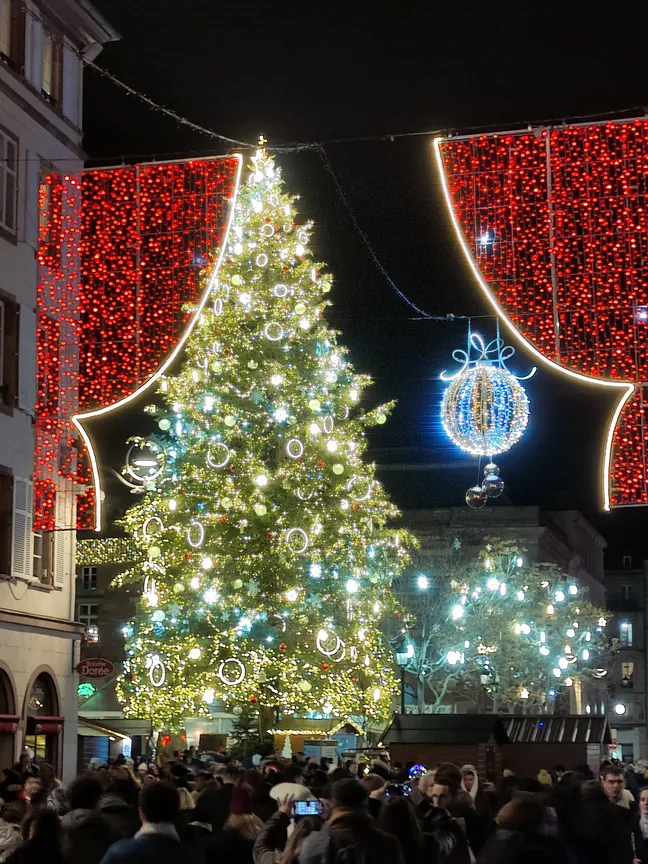
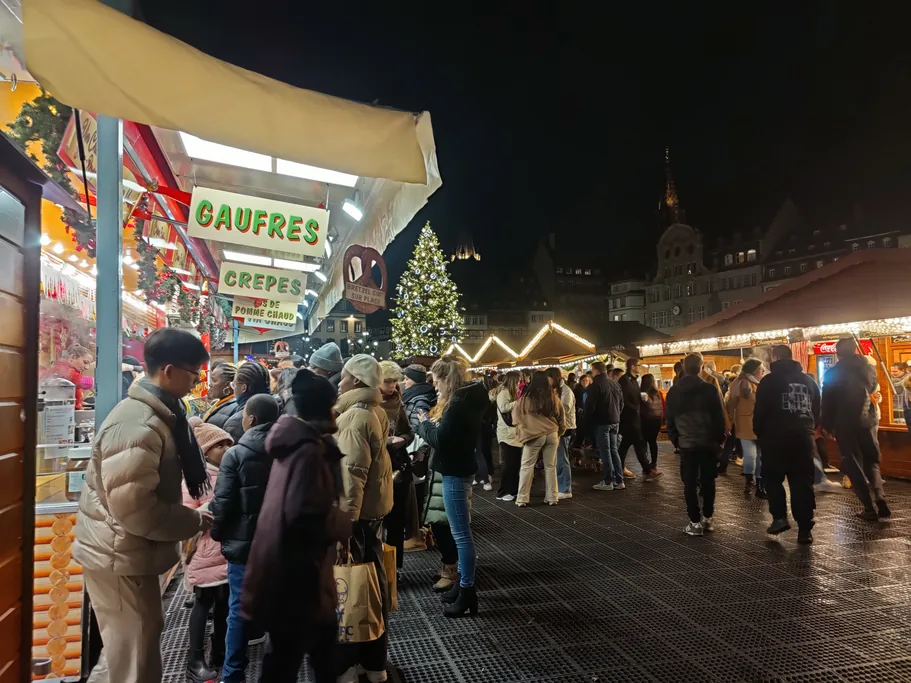
In December the words Capitale de Noël are everywhere in Strasbourg: on banners strung across the streets, on mulled wine mugs, on the sides of the trams. You might think the slogan has been around as long as the cathedral. In fact, city hall came up with it in the early 1990s, when the market was turned into a winter festival for the whole city. It does rest on real history, though. The Christkindelsmärik dates back to 1570, making it the oldest Christmas market in France, and Alsace has some of the earliest written records of the Christmas tree.
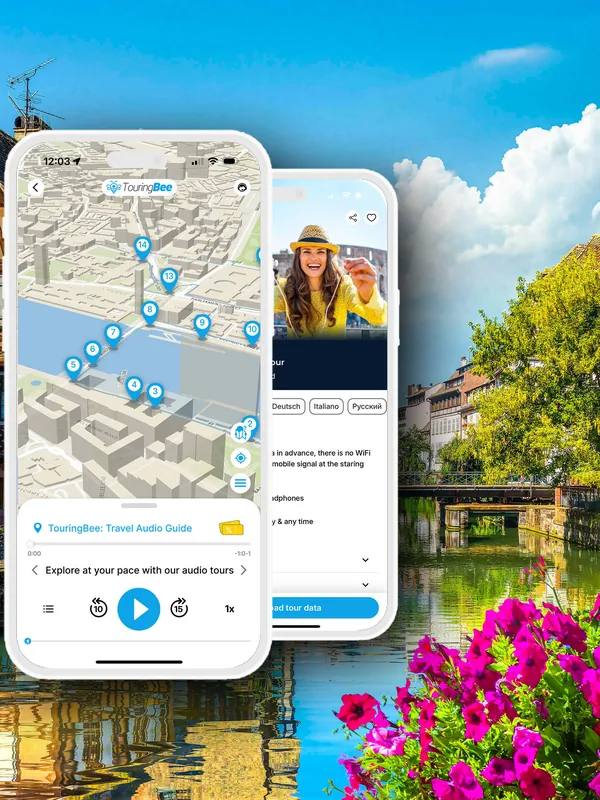
Strasbourg Self-Guided Audio Tour Instant access
Behind the decorations, it is easy to miss how far back the market's story goes. The chalets on Place Broglie stand where the market has been held for a century and a half, yet almost nothing there mentions its link to the Reformation. And by the cathedral, where it all began, it is hard to imagine that a Saint Nicholas fair once took place.
At a glance
| Key facts | |
|---|---|
| Slogan | Strasbourg, Capitale de Noël — since 1992, chosen by the city itself |
| Market | Christkindelsmärik, the Christ Child's market, since 1570 |
| Origin | Replaced the Saint Nicholas fair after the city turned Protestant |
| Location | First by the cathedral, on Place Broglie since the 1870s |
| Oldest | In France, yes. Germany has markets with earlier dates |
| Christmas tree | Sélestat: a record from 1521. Strasbourg: a 1605 description of decorated trees in homes |
| Visits | 3.05 million visits in the 2025 season, according to city hall |
A slogan four centuries younger than the market
In 1992 Strasbourg decided its Christmas market should be more than a row of wooden chalets on a single square. Under the banner Strasbourg, Capitale de Noël, markets spread across the squares of the city center and the streets got festive lighting. It worked. People started coming to Strasbourg specifically for Christmas, and today it is one of Europe's most visited winter destinations.
No official title was ever granted. "Capital of Christmas" is a tourism slogan the city picked for itself. The history it leans on, however, began long before anyone thought of tourism marketing.
1570: Saint Nicholas makes way for the Christ Child
In the 1520s Strasbourg embraced the Reformation and became one of the leading Protestant cities of the Holy Roman Empire. Printers here turned out the reformers' books, and theologians expelled from other places moved to the city. Before long, the holidays came under scrutiny too.
In medieval Strasbourg, the December fair was held around the cathedral and timed to December 6, the feast of Saint Nicholas. Saint Nicholas was the one who brought children their presents. Protestants objected, since the veneration of saints was one of the traditions the Reformation set out to reject. The Saint Nicholas fair was abolished, and in 1570 a new market opened by the cathedral, the Christkindelsmärik, or Christ Child's market. It ran in the last days before Christmas.
The change survives in the name. In Alsatian, Christkindel means "Christ Child" and märik means "market." The Christ Child was now the gift-bringer, and Protestant families moved their presents from December 6 to Christmas. Saint Nicholas never quite left Alsace, though. In early December, bakeries still sell mannele, little brioche men.
Four centuries and several changes of power
Over more than four centuries, power in Strasbourg changed hands more than once. In 1681 the free imperial city came under the French crown. After the war of 1870–1871 it became part of the German Empire, and in 1918 it returned to France. During World War II the city was occupied and de facto annexed by Nazi Germany until its liberation in November 1944.
The market survived all of it, although it moved more than once. It stood by the cathedral, on Place du Château and on Place Kléber before settling on Place Broglie in the early 1870s, where it is still held today.
That does not mean it never stopped. In 2020 the market was canceled because of the pandemic, for the first time in many centuries, according to city hall.
The Christmas tree: some of the earliest records
People often say the Christmas tree comes from Strasbourg. The story is a little more complicated. Alsace holds some of the earliest written records of the Christmas tree tradition, and one of them comes from Strasbourg.
- 1521, Sélestat. Municipal records from Sélestat, a town south of Strasbourg, show that on December 21, Saint Thomas's day, forest wardens were paid 4 shillings to guard the young fir trees in the town forest before the holiday. The original ledger is kept in the Sélestat municipal archives, and a copy is shown at the Christmas exhibition in the Humanist Library. The town itself calls it the first written mention of the Christmas tree.
- 1605, Strasbourg. An anonymous writer describes how, at Christmas, Strasbourg households set up fir trees and decorated them with roses cut from colored paper, apples, wafers, gold foil and sugar. It is one of the first descriptions of a decorated tree inside a home.
- 1640s, Strasbourg again. A local Lutheran theologian complained in print that his parishioners paid more attention to the trees in their homes than to the Word of God. When a preacher starts scolding a custom, it has clearly taken root.
None of this means Strasbourg invented the Christmas tree. The 1521 record only mentions guarding trees before the holiday. It says nothing about whether they were decorated. Trees were also put up for Christmas in other cities. Tallinn, for example, links its tradition to an archival document from 1441, although a public tree on a town square was not necessarily the same thing as a decorated tree at home.
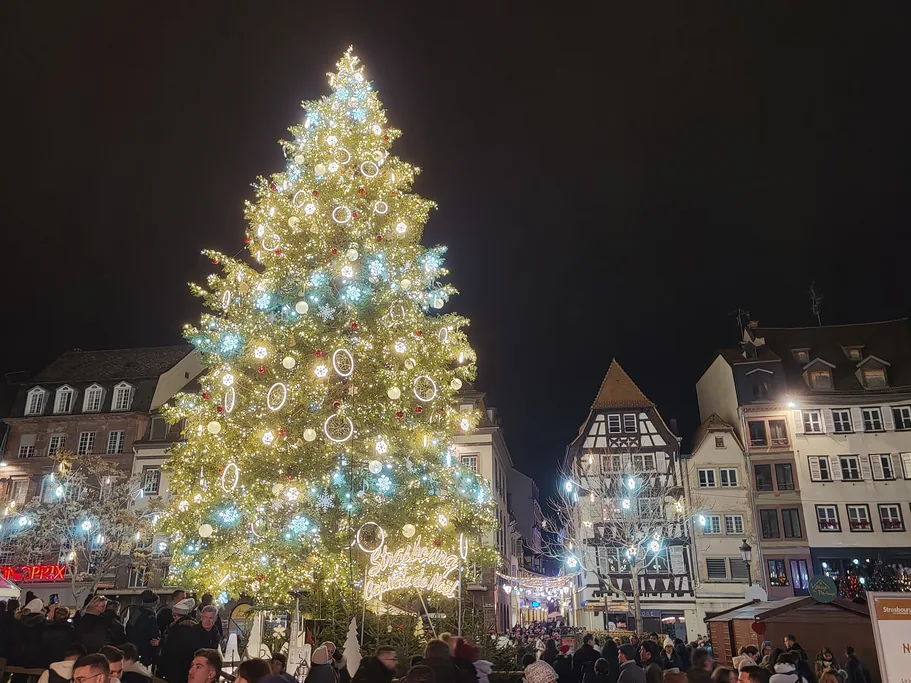
The Alsatian records are among the earliest in Europe, and the 1605 Strasbourg description is especially valuable for the history of the decorated tree at home. Today, the city's best-known Christmas symbol stands outdoors, in the middle of Place Kléber. Since 2000, a huge fir about 30 meters tall has been set up there every year.
The oldest in France, but not in Europe
The Christkindelsmärik traces its history to 1570 and is considered the oldest Christmas market in France. Germany, however, has even older markets. Dresden's Striezelmarkt is first mentioned in 1434, and Bautzen dates its market to 1384. The title of "biggest" is open to debate as well, since it depends on what is being counted: chalets, visitors or the area covered.
Where to see this history in the city
The 16th-century dispute left traces in Strasbourg that are easy to reach on foot:
- Saint Thomas Church — Protestant since 1524 and still one of the city's main Protestant churches.
- Old Saint Peter's — two churches, one Catholic and one Protestant, stand side by side, each with its own entrance.
- The cathedral — the market itself began by its walls.
- Place Broglie — home of the Christkindelsmärik since the 1870s.
Without the historical background, it is easy to walk past and never notice how the city's church history and the history of its Christmas market are intertwined.
The flip side of fame
Over a few weeks, Strasbourg's Christmas events draw millions of visits, which puts real pressure on a small historic center. The busiest areas are around the Christmas tree on Place Kléber and the cathedral, especially on the weekends before Christmas, so it's more pleasant to visit them on weekday mornings. In 2026, the Strasbourg Christmas market will run from November 27 to December 24.
During the market, the historic center becomes a zone with tighter security. Bags may be checked at the entry points, and car traffic in the center is restricted.
Place Broglie is about a fifteen-minute walk from the train station. You can check train times and tickets from Paris, Frankfurt and Basel on SNCF Connect, and in December it pays to book early. A regional train also makes Sélestat an easy trip, and at Christmas the Humanist Library there displays a copy of the 1521 record.
Accommodation for December is worth booking well ahead, as the good options in Strasbourg go fast. If you'd like to explore Strasbourg with a guide during the Christmas season, you'll find walking tours on GetYourGuide.
Strasbourg with an audio guide
The TouringBee audio tour starts at the Pont Kuss, five minutes from the train station, and runs through the whole historic center. Start whenever you like and play each recording when you reach the stop. You can pause the tour and pick it up again the next day, since access lasts a full year.
- 33 stops, about 2.5 hours at your own pace, recordings of 1–3 minutes.
- From €9.99, one-time payment, one year of access, 8 languages.
- Download the tour in advance, and the map and recordings will work without an internet connection.
- The map shows where you are, making it easy to find the next stop.
Ready to explore Strasbourg?
The "Capital of Christmas" slogan is a recent invention. The market itself grew out of a 16th-century dispute over who should bring children their presents. In December, walking past the chalets on Place Broglie, it is worth remembering that it all started with the abolished Saint Nicholas fair by the cathedral.
Frequently asked questions
Why is Strasbourg called the Capital of Christmas?
In 1992 the city chose the slogan Strasbourg, Capitale de Noël for itself. Real history stands behind it: the Christkindelsmärik Christmas market dates back to 1570, making it the oldest in France, and Alsace holds some of the earliest written records of the Christmas tree.
When did the Strasbourg Christmas market begin?
In 1570. After the city turned Protestant, the Saint Nicholas fair was abolished and replaced with a market for the Christ Child, held in the last days before Christmas.
What does Christkindelsmärik mean?
It is Alsatian for "the Christ Child's market." The name reflects that shift: the Christ Child replaced Saint Nicholas as the bringer of presents.
Is it the oldest Christmas market in Europe?
No, it is the oldest in France. Dresden's Striezelmarkt is first mentioned in 1434, and Bautzen dates its market to 1384.
Did the Christmas tree come from Strasbourg?
Alsace holds some of the earliest written records of the tradition. The 1521 Sélestat record concerns guarding trees before the holiday, and the 1605 Strasbourg text describes decorated firs in people's homes in detail. Calling Strasbourg the birthplace of the Christmas tree would be an exaggeration, since trees were also set up for the holiday in other cities, Tallinn among them.
Is "Capital of Christmas" an official title?
No, no organization awards it. It is a tourism brand the city has used since 1992.
Keep reading
- Strasbourg travel guide — the essentials about the city
- The Strasbourg Christmas market — squares, 2026 dates and security
- The best Christmas markets in Europe — how Strasbourg compares with Dresden, Cologne and Vienna
- Strasbourg in winter — weather and things to do before and after the market
- Strasbourg Cathedral — the facade, stained glass, astronomical clock and 330 steps

Eugene has lived in France for 16 years and worked as a tour guide before founding the travel-content network paris10.travel. He wrote the TouringBee audio tour of Strasbourg.
Every price and opening time on this page is checked against the official source for the current year. Where a fact is not yet published, we say so instead of guessing.
TouringBee audio tours are our own product. Links to GetYourGuide, Booking.com and SNCF Connect are affiliate links. If you book through them, we may earn a small commission at no extra cost to you. These partnerships never influence our recommendations.