
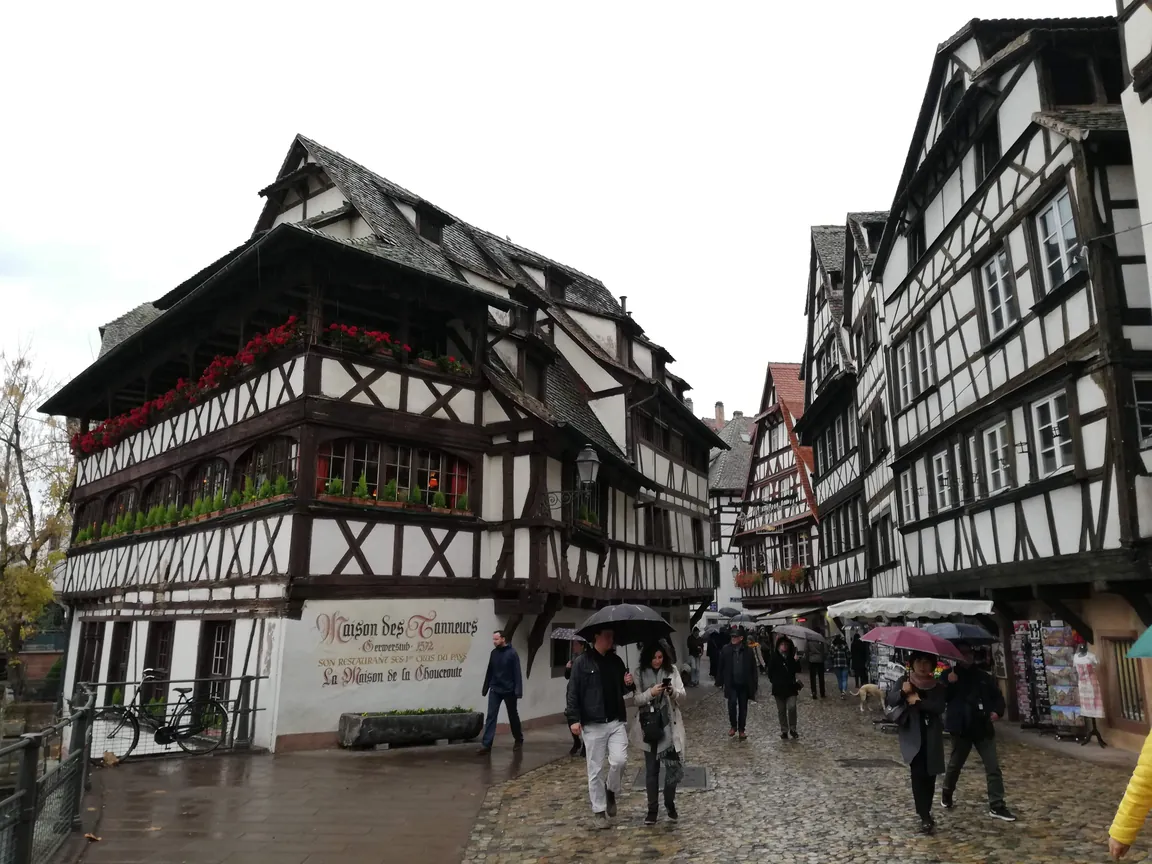
"Top ten restaurant" lists go stale fast: chefs move on, owners sell up, menus change. In Strasbourg it is more useful to understand the things that stay more or less the same. Start with restaurant opening hours and the local winstub tradition. Then there is the question of which neighborhoods to explore and what to look for before choosing a table.
Strasbourg Self-Guided Audio Tour Instant access
Exploring on your own has one pleasant advantage: you stop for lunch whenever it suits you, with no group to keep up with. On the TouringBee audio tour, there is a stop on Rue des Moulins where the guide talks about local food and calls it the most fragrant street in town. What to order is covered in our guide to what to eat in Strasbourg. This one is about where and when.
At a glance
| Key facts | |
|---|---|
| Lunch in traditional restaurants | Roughly 12:00–2:00 p.m. |
| Dinner | Usually from 7:00 p.m., last orders depend on the restaurant |
| Around 4:00 p.m. | Brasseries, cafés and places marked service continu |
| Good-value lunch | Lunchtime set menu (formule midi) or the dish of the day (plat du jour) |
| Away from the tourist streets | Krutenau, east of the historic center |
| Reservations | In December, especially on weekends, for popular restaurants in the center |
| Water | When you order food, a jug of tap water (une carafe d'eau) comes free |
When restaurants are open, and where to eat between lunch and dinner
In many traditional restaurants, lunch runs from about noon to two, and dinner starts around seven. When the kitchen takes its last orders depends on the place: a restaurant may stay open after the cooks have finished for the night. Between lunch and dinner, many places don't serve hot food at all. But you can still find something to eat at 4 p.m. Look for brasseries, cafés and places offering continuous service. Bakeries are another good option for a quick snack.
Before you sit down, read the menu at the door. In France it is usually posted outside, but it is worth checking the kitchen hours separately. The sign service continu means the place serves guests without an afternoon break. If you want a proper hot meal, though, ask which dishes are available at that time. For a lunch deal, look for formule midi or plat du jour, and check until what time the offer runs.
- Lunch can be better value than dinner. At lunchtime many restaurants offer a dish of the day or a set menu of two or three courses at a better price than ordering à la carte. If you want to save money, make lunch your main meal.
- Order to share. Flammekueche is ideal for sharing. Order one for the table, then try another topping if everyone wants more.
- Tipping. Service is already included in the bill, so an extra tip is optional. If you were happy with the service, you can round up the bill.
- Cash. A little cash comes in handy at the market and in small places, although most restaurants take cards.
What is a winstub?
Winstubs were once simple places where Alsatian winemakers sold their wine and served home cooking to go with it. The name Winstub literally means "wine room." Today a winstub is usually a restaurant serving traditional food in a relaxed setting. Many have a short menu of regional dishes and wood-paneled rooms, and the wine comes in small glasses or jugs.
Menus and interiors vary a lot from one winstub to the next. Checked tablecloths and Alsatian wine glasses with green stems are familiar touches, though you won't find them everywhere. They create atmosphere but say nothing about the quality of the cooking. So when choosing a winstub, the menu and recent reviews are more useful.

Neighborhoods: where to look for food
All these neighborhoods are close to the historic center, and you usually won't need public transport to explore them.
Petite France and Rue des Moulins: pretty and touristy. Rue des Moulins is lined with restaurants, and its canal-side terraces are among the most sought-after in Strasbourg. The setting and the view can push prices up, so compare a few menus before you order: the side streets nearby often have more affordable options. You can read more about the quarter in our guide to Petite France.
Rue Mercière and the cathedral lanes: lively, with quieter options nearby. Rue Mercière leads straight to the cathedral's west front, so it is full of visitors. There are good places on the street itself, but the lanes north and east of Place de la Cathédrale tend to be calmer.
Krutenau: away from the busiest streets. This student neighborhood lies across the river, east of the historic center, about ten minutes on foot from the cathedral. Krutenau is full of small restaurants and wine bars. You can choose between traditional Alsatian and international food, and if you are watching your budget, compare a few menus. If you spent your first evening by the canals, the second is a good one to spend here.
Neustadt: quieter and more modern. The German imperial quarter around Place de la République has wide avenues, a calm feel and restaurants of every kind.
Place Broglie: fresh produce. On Wednesdays and Fridays a morning food market is usually held here. Bread, cheese and charcuterie from the market make a good picnic.
If Alsatian cooking leaves you curious to taste the local wines where they are made, head out of Strasbourg. You could take the train to Colmar and carry on along the Alsace Wine Route. Train tickets are easy to book in advance. If you would like to visit several wineries without driving, a wine tour departing from Strasbourg is a convenient option.
How to judge a place before you sit down
You can't spot a good restaurant from a single outward sign. But the menu, recent reviews and a few details at the door will help you decide whether to stop.
- When to check the reviews. If a place promises dozens of dishes from different cuisines, from flammekueche to sushi, read some recent reviews and find out what it actually specializes in. Multilingual menus and photos of dishes are common in tourist areas and aren't necessarily a bad sign. But if someone outside is aggressively trying to draw you in, take a look at the nearby restaurants before deciding.
- What to look for. A short menu that changes with the seasons and a dish of the day can both be good signs. A wine list that names the producers gives you a clearer idea of the wines on offer. Alsatian dish names on the menu tell you what the place specializes in. Look at the other diners too, but remember that a full room in the tourist center doesn't guarantee good food.
Reservations and December
On an ordinary weekday it is often easier to find a table without booking, especially if you arrive at the start of lunch or dinner service. Popular winstubs, though, are worth booking in any season.
In December, especially on weekends, it's best to book ahead at popular restaurants in the city center because of the crowds visiting the Christmas market. If you would rather not be tied to a reservation, have several options in mind, including places with continuous service. Turning up at the start of evening service sometimes helps you get a table, but in December even that is no guarantee.
Plenary sessions of the European Parliament bring another busy period. More people come to Strasbourg during those weeks, hotels for those dates fill up early, and it gets harder to find a free table in popular restaurants in the center. If your trip coincides with a session, it is wise to book dinner.
Three special cases
Vegetarians. Many traditional Alsatian dishes contain pork, so it pays to read the menu in advance. In a traditional winstub there may be only one or two options. If in doubt, ask the waiter: Est-ce que vous avez des plats végétariens ? ("Do you have vegetarian dishes?"). Modern restaurants and places serving international food usually offer more choice. Our guide to what to eat in Strasbourg explains which local dishes work.
With children. Flammekueche works well for families: it is easy to share, and you can choose toppings the children will enjoy. With kids it helps to arrive early, at the start of evening service, so dinner doesn't drag on too late. At popular restaurants, book a table. If the children get hungry mid-afternoon, places with continuous service will save the day.
Late in the evening. Traditional winstubs often close their kitchens fairly early. If you want a late dinner, look for a brasserie around Place Kléber and Place Gutenberg or somewhere in Krutenau. Always check when the kitchen takes its last orders, since an open restaurant doesn't necessarily mean you can still eat there. This matters most if you arrive on a late train.
Strasbourg with an audio guide
The TouringBee audio tour starts at the Pont Kuss, five minutes from the train station, runs through the whole historic center and ends at St Paul's Church. You start each recording yourself when you reach the stop, so you can break for a long lunch at any point and carry on afterwards.
- 33 stops, about 2.5 hours at your own pace, recordings of 1–3 minutes.
- From €9.99, one-time payment, one year of access, 8 languages.
- Download the tour in advance, and the map and recordings will work without an internet connection.
- The map shows where you are, making it easy to find the next stop.
Ready to explore Strasbourg?
Even a good restaurant can disappoint if you walk in at random just as the kitchen is getting ready to close. So check the kitchen hours, compare menus and don't hesitate to explore a nearby side street. At lunch, look for good-value deals, and in December, book your dinner table. That way you stand a better chance of finding a place that suits you.
Frequently asked questions
What is a winstub?
A traditional Alsatian establishment where local wine was once sold alongside home cooking. Today it is usually a restaurant serving regional food in a relaxed setting.
Where can I eat away from the tourists?
Krutenau, the student neighborhood east of the historic center, has plenty of small restaurants and bars. The Neustadt, around Place de la République, is quieter and more modern.
What are restaurant opening hours?
Traditional restaurants usually open their kitchens for lunch and dinner, with a break in between. If you want to eat in the afternoon, look for places marked service continu and ask whether they serve hot food.
How do I choose a good place?
Start with the menu at the door and recent reviews. A short seasonal menu and a dish of the day can be good signs, but none of them guarantees good cooking.
Is it expensive to eat in Petite France?
By the canals, the view can push prices up. Compare a few menus: the nearby side streets often have more affordable options.
Do I need to book a table?
On ordinary weekdays you can often get a table without booking if you arrive at the start of service. In December, especially on weekends, popular restaurants in the center are best booked ahead.
How can I eat well on a budget?
Look for a lunchtime set menu (formule midi) or the dish of the day (plat du jour). Or put together a picnic from one of the city's markets.
Keep reading
- Strasbourg travel guide — the essentials about the city
- Petite France — the picturesque quarter with canal-side terraces
- One day in Strasbourg — an hour-by-hour route with lunch at the right time
- The Strasbourg Christmas market — why restaurant tables book up fast in December
- Strasbourg Old Town — the Grande Île on foot

Eugene has lived in France for 16 years and worked as a tour guide before founding the travel-content network paris10.travel. He wrote the TouringBee audio tour of Strasbourg.
Every price and opening time on this page is checked against the official source for the current year. Where a fact is not yet published, we say so instead of guessing.
TouringBee audio tours are our own product. Links to GetYourGuide, Booking.com and SNCF Connect are affiliate links. If you book through them, we may earn a small commission at no extra cost to you. These partnerships never influence our recommendations.