Still planning the whole trip? Start with our complete guide to Strasbourg, then come back here for the cathedral.
It is easy to "see" the cathedral in twenty minutes: the facade, the nave, the clock, and then move on. That is a shame, because almost everything here starts to make sense once someone points out what to look for — a facade that is not one wall but two, a portal that got its missing angel back in May 2026, and glass that is older than the walls around it.
Start with the building itself: the facade, the interior, when to come, and what you will pay. If you want to understand the mechanism, the figures, and the 12:30 show, the guide to the astronomical clock goes into all of it. And if you want to understand what you are looking at rather than just look, we made the TouringBee self-guided audio tour of Strasbourg, from €9.99.
The nave has a midday break, so dropping in on the way past at lunchtime does not always work. Staying on the Grande Île puts you five minutes away, which makes the timetable easy to work around.
Strasbourg Self-Guided Audio Tour Instant access
At a glance
Nave
| When | Hours |
|---|---|
| Mon–Sat | 08:30–11:15, 12:45–17:45 |
| Sundays and feast days | 14:00–17:15 |
| During the Christmas market, Mon–Sat | 08:30–17:45, no midday break |
The cathedral may close for services, and there is a security check at the entrance. During the Christmas market, entry is through the south portal on the Place du Château side.
Observation platform
| Season | Hours |
|---|---|
| Apr 1–Sep 30 | 09:30–13:00, 13:30–20:00 |
| Oct 1–Mar 31 | 10:00–13:00, 13:30–18:00 |
Last ascent 45 minutes before closing. Closed Jan 1, May 1, and Dec 25.
What it costs
- Nave — free
- Astronomical clock — €4, show at 12:30. No show during the Christmas market
- Observation platform — €10, 330 steps, no elevator
Reduced rates exist, so check them on the cathedral's official website before you go.
The pink stone, and why the scaffolding keeps coming back
The cathedral is built from several kinds of Alsatian sandstone. Most of the Gothic building is fine-grained grès à meules, also called grès à Voltzia, while the coarser grès vosgien survives mainly in the oldest, Romanesque parts, including the crypt.
The stone was quarried within twenty or thirty kilometers of the site — Wasselonne, Dinsheim-sur-Bruche, Gresswiller. The pinks and reds come from iron compounds, which is why the cathedral, the Palais Rohan, and half the Grande Île share one palette. That is why the cathedral never has just one color: apricot at sunset, gray-lilac under cloud, almost red when rain soaks in.
The catch is that sandstone drinks water, darkens and crumbles at the edges over decades rather than centuries. Look closely at any wall and you see the patchwork — pale new blocks beside blackened old ones, like fillings in a jaw.
So Strasbourg has an institution few cathedrals can match. The Fondation de l'Œuvre Notre-Dame, first documented in the 1220s, was set up to build and maintain this church and is still at work. It is one of the rare European cathedral workshops whose tradition goes straight back to the Middle Ages.
In 2020 the knowledge, skills, and practices of Europe's cathedral workshops, Strasbourg's among them, were added to UNESCO's Register of Good Safeguarding Practices. Its masons still cut replacement stone by hand, with traditional tools alongside modern ones, a hundred meters from the building.
They will not finish, either. The historic quarries have closed or been turned to other uses, so replacement stone now comes from farther afield: Adamswiller, Langensoultzbach and Weislingen in Alsace, Niderviller in Lorraine, Neubrunn and Bitburg in Germany. Choosing a compatible replacement stone is now an important part of every restoration.
How to read the west facade
Step back to the far side of Place de la Cathédrale — the square is tight, so this gives you the clearest view of the facade. From there you can see that the facade is built in two layers.
Erwin von Steinbach, who directed work on the lower facade from about 1284, pushed what the Fondation calls the concept de double paroi to its limit: a massive load-bearing wall, with a freestanding screen of mullions, arcading, and gables set in front of it. The Fondation's own name for it is the harpe de pierre, the stone harp.
As the sun moves, the front layer throws shadows on the back one and the whole facade ripples. It is an effect of light and shadow conceived in the thirteenth century and still working.
It is also held together with iron. Dowels and cramps run through the fabric, anchoring elements too slender to stand on stone alone. So much for Gothic cathedrals being nothing but stone and mortar.
Then come the stories. The portal sculptures formed a visual narrative: you could recognize the scenes without reading a word. Prophets line the central doorway, the Virtues trampling the Vices stand at the left-hand (north) portal, and the Wise and Foolish Virgins at the right-hand (south) portal. The tympana above the doors carry the story from the childhood of Christ through the Passion and Resurrection to the Last Judgment.
The rose window is 13.60 meters across — a five-story building turned on its side.
Go to the right-hand portal and find the Wise and Foolish Virgins, with the Tempter offering an apple. He is a handsome young man dressed in the fashion of the day, and he is worth walking around. These are sandstone copies, completed in 1971, and the originals were removed from the facade between 1907 and 1914 and are now in the Musée de l'Œuvre Notre-Dame, forty meters away.
Then walk around the outside. Flying buttresses carry the thrust of the vaults out — and double as gutters, roof water running down inside them and out through the gargoyles. Structure, decoration, and plumbing in one component.
On the audio tour we take a closer look at the Tempter's back — there is a detail there that is easy to miss if you only look from the front.
The Saint-Laurent portal, and the angel that came back
On the north side is the Saint-Laurent portal, showing the martyrdom of Saint Lawrence. For five years you could see none of it.
That restoration is finished. The portal was inaugurated on May 11, 2026, and it is worth going over to see one small figure: the Nativity angel, the ange à l'étoile, missing from the portal for at least two centuries. The original was rediscovered in the museum's collections by the Fondation's historian Sabine Bengel, and a new copy was carved based on it by Vincent Cousquer in the Fondation's workshops.
The cost of the restoration is worth a word of its own, because it shows what keeping a building like this takes. The work carried out by the Fondation itself — masonry, stone cutting, and sculpture — was valued at roughly €2.4 million. The French state, through DRAC Grand Est, provided €873,000 for its share of the work — studies, carpentry, roofing, ironwork, stained glass, and joinery.
You can tell at a glance that the angel is new — the stone is pale and slightly too clean beside its neighbors. Time will darken it. That is the honest condition of this building: not a monument under glass, but a building under continuous care, one stone and one sculpture at a time.
What to look for
| What to find | Where | Why it is worth the stop |
|---|---|---|
| The double facade, or "stone harp" | West facade, from the far side of the square | Light and shadow ripple across it as the sun moves |
| Wise and Foolish Virgins, with the Tempter | Right-hand (south) portal of the west facade | Walk around the Tempter, then see the originals in the museum next door |
| Flying buttresses and gargoyles | Outside, walking around the building | Structure and drainage in one |
| Nativity angel | Saint-Laurent portal, north side | Back on the portal since May 2026 |
| Pillar of Angels | South transept | A thirteenth-century sculpted pillar that also holds up the vault |
| Organ automata | North wall of the nave | Three articulated figures below the organ case |
The audio guide
The TouringBee self-guided audio tour of Strasbourg is a walk through the city with a narrator instead of a guide with an umbrella. What you have just found outside, and much of what waits inside, we explain on the spot.
- 33 stops, about 2.5 hours at your own pace, 1- to 3-minute recordings
- From €9.99, one payment, one year of access, 8 languages
- Works offline once downloaded — no roaming or Wi-Fi needed
- How the map works: the app shows an offline GPS map with your position on it, so you always know where you are and what is next. You press play yourself when you arrive, so the audio never starts on its own at the wrong moment — especially inside an active church
"I'm a 64 year old female solo traveler. I walked around the city of Strasbourg whole day with this guide, taking a break at my hotel room as needed. It's flexible yet comprehensive. The length of recording at each of the 33 landmarks was just right (2–3 minutes)."
— Reiko_T, Viator, September 2025
Get the Strasbourg audio tour — from €9.99
Inside: the glass, the pillar, the organ
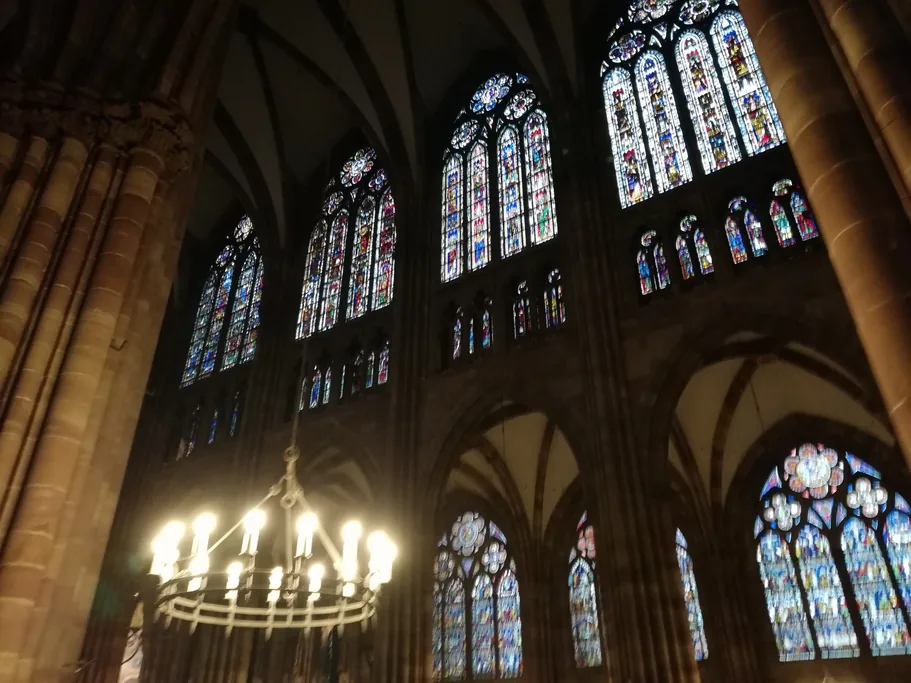
The nave is free, though there can be a line for the security check. The cathedral is 112 meters long, 118 including the cloister. The vaults rise 32 meters overhead, so your eyes naturally travel upward. The Gothic nave itself is only 40 meters long, while the west facade alone is 51.50 meters wide.
Stained glass
Give your eyes a minute. The interior is dark, and the reward is in the windows: about 1,500 square meters of figurative stained glass, twelfth to fourteenth century. The oldest panels were salvaged from the Romanesque cathedral that stood here before this one — glass older than the walls around it. In the north aisle, a row of severe, elongated Holy Roman Emperors look like they are lining up for something.
Pillar of Angels
In the south transept, standing alone, is the Pillar of Angels: one thirteenth-century column carrying twelve statues in three tiers — the four evangelists at the bottom, four angels with trumpets above them, Christ and three more at the top. It is among the finest works of Gothic sculpture in the Rhine Valley, and the pillar itself holds up the vault.
Before you walk on, look at the balustrade above and to one side, where a stone man is leaning on his elbow, staring at the pillar. He is not a saint and he is not decoration.
Organ and automata
Then the organ, hanging off the north wall like a swallow's nest. The case is Flamboyant Gothic, built in 1489 by Friedrich Krebs, while the hanging base beneath it is older still, dating to 1385. The instrument inside is not the one Silbermann built: André Silbermann signed the contract in February 1714 and finished in 1716, and the instrument heard today is Alfred Kern's 1981 organ, forty-seven stops, incorporating surviving pipework from Silbermann's organ.
Below the case are three articulated figures: a trumpeter on the left, Samson opening the lion's jaws in the center, and the Rohraffe — also known as the Bretzelmann — on the right. They were not decoration either — they had a job, and it was not a reverent one.
What the stone man on the balustrade is waiting for, and what the man hidden behind the Rohraffe used to do at Pentecost, we explain on the audio tour.
The astronomical clock
Also in the south transept, impossible to miss: the astronomical clock, a Renaissance ensemble whose current mechanism, created by Jean-Baptiste Schwilgué, dates from 1842. It shows the time, the date, the phase of the moon, the movement of the planets as far out as Saturn, the movable feasts, and lunar eclipses. The main show, with the parade of apostles, runs once a day at 12:30. What each figure means is in our guide to the astronomical clock.
How to see the show:
- a film begins at 12:00, followed by the show at 12:30
- tickets are sold in the cathedral shops until 11:00, then at the Saint-Michel door off Place du Château from 11:30
- same-day tickets only, no advance sales
- no show on Sundays or church feast days when an 11:00 Mass is celebrated
- no show while the Christmas market is on
330 steps to the platform
330 steps, no elevator, 66 meters up, to the observation platform on top of the west facade, at the foot of the north tower. A narrow stone spiral staircase takes you up, and it is not a good choice for anyone with bad knees or a dislike of tight spaces. The nave, by contrast, has step-free access on the north side — do not let "no elevator" put you off the building itself.
From the top you can see the whole Grande Île, with the Ill wrapping around it, the covered bridges to the west, the Black Forest on the German horizon, and the Vosges behind you. The spire rises another seventy-six meters above you. You are not halfway up.
Timing is everything, because there is nothing to reserve. Go in the first hour after opening or the last two before closing, never mid-afternoon on a summer Saturday. The tower also shuts 13:00–13:30 all year, and when the route reaches capacity, entry is paused for a while — at peak times expect to wait.
Four centuries of building, one spire to show for it
- 1015 — Bishop Werner begins construction of a Romanesque cathedral
- 1176 — fire, after which large-scale rebuilding begins around 1180
- c. 1284 — Erwin von Steinbach takes charge of the west facade
- 1419–1439 — Johann Hültz builds the north spire, 142.11 meters
- 1647–1874 — commonly considered the tallest building in the world
The present cathedral stands on the foundations of its Romanesque predecessor. In 1015 Bishop Werner laid the first stone of a Romanesque cathedral on marshy ground, and its foundations were reinforced with wooden piles driven into the clay. When rebuilding began a century and a half later, those foundations were kept, which is why the choir and transept still read as Romanesque while the facade is pure Gothic.
After the fire of 1176, and in earnest from about 1180, the rebuilding began. Along the way the new French Gothic arrived, and a Rhenish project acquired a French skeleton. Like the city, the cathedral is a compromise between two building cultures.
Method mattered as much as design. The masons worked in a covered workshop, so blocks could be cut all year round rather than only in the warm months. Heavy stones were hoisted by treadwheel cranes, powered by men walking inside a wooden drum.
Johann Hültz of Cologne built the openwork spire between 1419 and 1439, topping out at 142.11 meters. Then they stopped. The south tower rises only as far as the platform — its first story was finished by 1316 and Erwin's son added a second — and the south spire was never built.
The reason is not firmly established. Explanations include changing designs, priorities, and funding. Plans for a second spire kept appearing later, but none was carried out.
So: one enormous spire and a flat-topped south tower where a second spire was once contemplated. The silhouette stayed asymmetrical because the second spire never came, and that is what makes it unmistakable. It is commonly considered to have been the tallest building in the world from 1647 to 1874 — 227 years — until St. Nicholas' Church in Hamburg was topped out. That church now stands in ruins after wartime bombing and has been preserved as a memorial, and Strasbourg is still standing.
High in the towers hang the bells. Fourteen of them ring in the full peal, and only seven times a year — Easter, Ascension, Pentecost, the Assumption, All Saints, Christmas, and Epiphany. The great bourdon among them was cast in July 1427 by Hans Gremp, weighs about 8,850 kg, and is the oldest surviving bourdon in any French cathedral.
How to buy tickets
The nave is free. You only need tickets for the astronomical clock show and the platform climb, and both are sold on the day only — there is no way to buy in advance. Keep your platform ticket: it gets you a reduced rate at the Musée de l'Œuvre Notre-Dame next door, where the original figures of the Virgins are kept. Check with the museum to see how long the discount remains valid.
There are no skip-the-line tickets either. If someone online offers you "skip-the-line" for the cathedral, it is almost always a guided tour, not a faster way in. You will find those among the GetYourGuide options.
Ready to see it properly?
Walk all the way around the outside before you go in, and remember: the one thing you can control is when you arrive.
Frequently asked questions
Is Strasbourg Cathedral free to enter?
Yes. You pay only for the astronomical clock show and the platform. The nave has a midday break from 11:15 to 12:45, except during the Christmas market.
How tall is Strasbourg Cathedral?
142.11 meters to the tip of the north spire. It is commonly considered to have been the tallest building in the world from 1647 to 1874. The visitor platform is at 66 meters.
Why does Strasbourg Cathedral have only one tower?
The south tower exists but was never built higher than the platform, and its spire was never built. No one knows for certain why. Explanations include changing designs, priorities, and funding.
How many steps to the Strasbourg Cathedral observation platform?
330 steps to the platform at 66 meters, with no elevator. Tickets are €10, with reduced rates available, and are sold at the tower on the day.
Can I buy skip-the-line tickets for Strasbourg Cathedral?
No. Clock and platform tickets are sold on site, on the day only. Anything sold online is a guided tour, not a faster way in.
How much is a ticket for the astronomical clock show?
€4, with reduced rates. Tickets are same-day only. There is no show while the Christmas market is running.
Why is Strasbourg Cathedral pink?
It is built from several kinds of Alsatian sandstone, and iron compounds give the stone its pink-red tones. The color shifts with the light — warm at sunset, dark and purplish in rain.
Continue exploring
- Complete guide to Strasbourg — where to stay, when to go, what it costs
- The astronomical clock — the mechanism, the figures, and how to catch the 12:30 show
- Strasbourg walking tour — a free 90-minute loop that ends back at this square
- One day in Strasbourg — a timed route built around the 11:15 closure
- The Christmas market — when the cathedral's hours change and the clock show stops
- Strasbourg history — why the city looks both French and German

Eugene has lived in France for 16 years and worked as a tour guide before founding the travel-content network paris10.travel. He wrote the TouringBee audio tour of Strasbourg.
Every price and opening time on this page is checked against the official source for the current year. Where a fact is not yet published, we say so instead of guessing.
Some links on this page are affiliate links (GetYourGuide, Booking.com, SNCF). If you book through them we may earn a small commission at no extra cost to you. It never affects what we recommend.