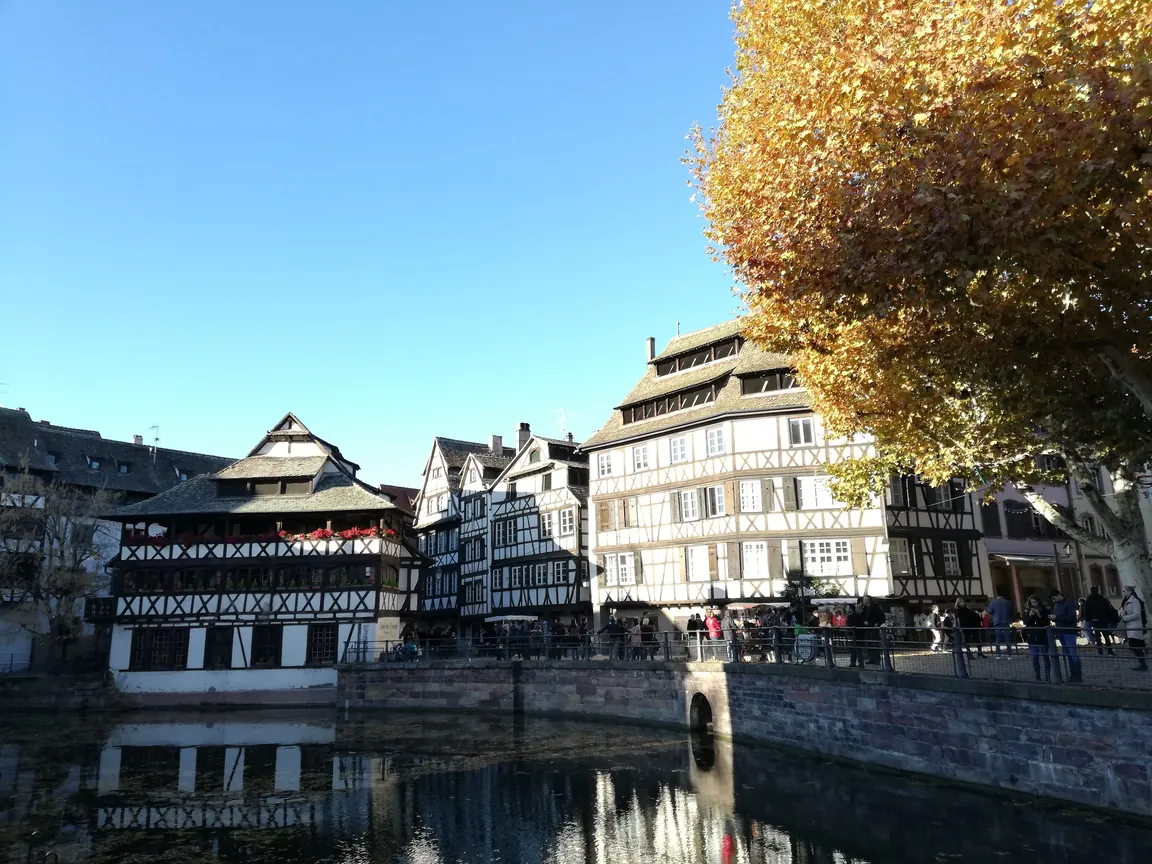
Petite France covers the western tip of the Grande Île, the island that holds Strasbourg's historic center. There's no entrance gate or admission fee, and nothing marks the quarter's boundaries. You can walk through it looking only at the facades. But if you know where to look, you'll notice the open lofts beneath the roofs, the towers beside the water, and the dam with one of the best rooftop views in Strasbourg.
The TouringBee audio tour of Strasbourg makes several stops in Petite France. The guide helps you see the history of a working quarter behind the pretty facades and understand how its bridges and fortifications worked.
Strasbourg Self-Guided Audio Tour Instant access
At a glance
| Details | |
|---|---|
| Where | Western end of the Grande Île, about 15 minutes on foot from the train station |
| Entry | Free: the streets, bridges, Ponts Couverts and Barrage Vauban cost nothing |
| Main street | Rue du Bain-aux-Plantes |
| Viewing terrace | On the roof of the Barrage Vauban, free, hours vary by season |
| Status | Part of the Grande Île UNESCO World Heritage Site since 1988 |
Where the name comes from
In the early 16th century, a hospital for syphilis patients opened on this bank. The disease had only just reached Europe, and German speakers called it the French disease, so locals nicknamed the hospital Zum Französel, roughly "the little Frenchman's." Later the name passed from the building to the whole quarter. There was never a French community here.
Craftsmen settled on this stretch of the river for a different reason: tanners used the running water, millers the force of the current, and fishermen kept their boats here. Here the Ill splits into several faster-flowing channels. Tanning hides also produced a powerful smell, so it made sense to keep the workshops away from the cathedral and the wealthier streets. That is how the western end of the island became a working quarter.
The traces are still visible. Beneath the steep roofs of many houses, you'll notice open attic spaces that can easily be mistaken for balconies. These were once used to dry hides. The best-known example is the Maison des Tanneurs at 42 Rue du Bain-aux-Plantes. It grew out of several 16th-century buildings, one of which bears the date 1572. Today it houses a restaurant serving Alsatian food.
How the quarter is laid out
From the center, Grand'Rue, one of Strasbourg's oldest streets, leads toward Petite France. The Maison des Tanneurs stands on Place Benjamin-Zix, named after a Strasbourg painter of the early 19th century. The quarter's main street, Rue du Bain-aux-Plantes, starts from the square. Its name recalls a public bathhouse that once stood here.
On the other side of the channel runs Rue des Moulins, the millers' street. Today nearly every house on it has a restaurant. At the end of Rue du Bain-aux-Plantes, the Pont du Faisan crosses the channel and links the two streets. It is a swing footbridge: when a tour boat approaches, the deck pivots aside to let it through.
These two streets and the waterfront between them are where the houses from the postcards stand. At the restaurants by the water, you're paying partly for the view. If you'd rather save a little, try one of the traditional Alsatian wine taverns, known as winstubs, on the neighboring streets.
The finest facades here face the water, not the street. So it is worth walking out along one bank of the channel and back along the other: the houses on each side are different. Old locks survive between the branches of the Ill, and from the bridge you can watch Batorama boats pass through them.
The Ponts Couverts
At the western edge of the quarter stand three massive square towers from the 13th century, linked by bridges. These are the Ponts Couverts, or covered bridges, a surviving part of the medieval fortifications. There were originally four towers, but one of them, the Malzenturm, was demolished in 1869.
Covered wooden galleries once ran above the bridges, so the city's defenders could move between the towers under shelter. The galleries were taken down in 1784, but the name stuck. The present stone bridges were built between 1863 and 1865, and today anyone can walk across them.
The towers also had another, far less romantic life. Why they were kept once they could no longer defend the city is something you will hear on the TouringBee audio tour.
The Barrage Vauban and its free terrace
Across from the Ponts Couverts, a long, low sandstone structure on thirteen arches spans the river. It is easy to mistake for an ordinary bridge, but this is the Barrage Vauban, built at the end of the 17th century to the plans of Vauban, Louis XIV's chief military engineer. Each arch held sluice gates. Lower them, and the Ill would rise and flood the approaches to the city from the south.
Inside the dam runs a covered gallery displaying historic sculptures and casts connected with Strasbourg Cathedral. At the end of the gallery, stairs lead up to a panoramic terrace that stretches the full length of the dam. It opened in 1966. In front of you are the Ponts Couverts, behind them the roofs of Petite France, and above it all the cathedral spire. From the riverbank the dam looks fairly plain, so walk through the gallery and climb up to the terrace for that view.
Strasbourg Cathedral also has a viewing platform with sweeping views of the city. But reaching it means climbing 330 steps and paying an admission fee. The Barrage Vauban terrace, by contrast, is free.
| Barrage Vauban terrace | Opening hours |
|---|---|
| May–August | 07:15–21:00 |
| September–October, March–April | 08:00–19:00 |
| November–February | 08:30–16:00 |
The lower passage through the dam is open every day from 06:00 to 21:00. The terrace also has an elevator, but both the elevator and the stairs were undergoing replacement work in 2026. Before visiting, check the City of Strasbourg website for the latest information on elevator access and terrace hours.
When to come
Early morning. The quarter is usually quieter, and in calm weather the half-timbered facades are reflected beautifully in the water.
Late afternoon. The low sun shines in from the west along the channels, casting a warm glow over the half-timbered facades. It is a good time for the terrace on the dam, but keep in mind that in winter it closes at 16:00.
Summer afternoons. From late morning until evening the quarter is busy. Rue du Bain-aux-Plantes is narrow, and a single tour group can block it for a while.
December. The restaurants on Rue des Moulins compete over their facade decorations, and the quarter looks especially festive. But in the afternoon it can get very crowded, with nowhere to step aside on the narrow streets. If you are coming for the Christmas market, visit Petite France in the morning.
In the rain. The wet cobblestones shine, there are fewer visitors, and the covered gallery of the Barrage Vauban is an easy place to shelter.
Where to take photos
The best-known shot of Petite France is taken not from inside the quarter but from the Ponts Couverts: stand on the bridge between the towers and look east, and the frame holds half-timbered houses, water, a lock and the cathedral spire.
A few more spots:
- The Barrage Vauban terrace — a wide panorama of towers, water and roofs, especially in late afternoon.
- The Pont du Faisan — from the middle of the bridge you can see the channels in both directions.
- The Pont Saint-Martin, just east of the quarter — a good view of the old mills and weirs. They were once busy workplaces, but later the mills began a very different life. You can hear the story on the TouringBee self-guided audio tour.
Petite France with an audio guide
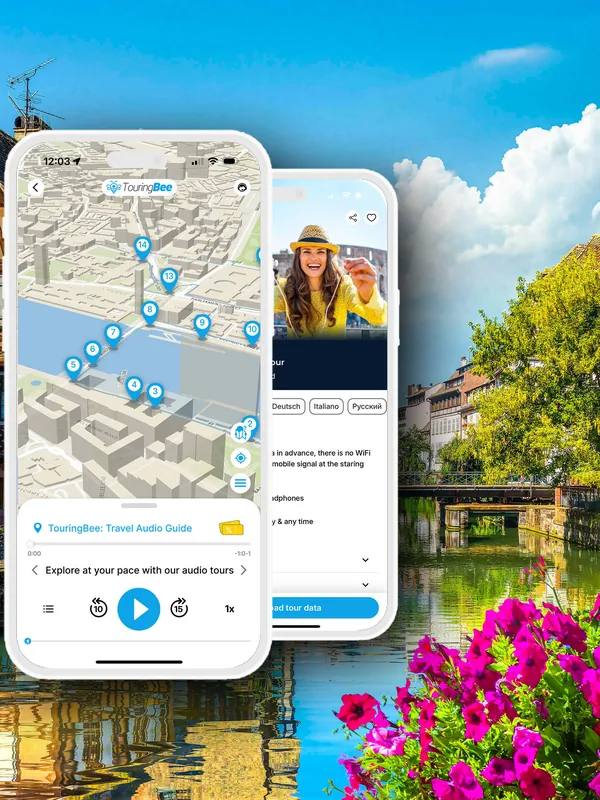
The TouringBee audio tour starts near the train station and passes through Petite France, the Ponts Couverts and the Barrage Vauban. You can start whenever you like and play each recording when you reach the stop. In Petite France that is especially handy: linger on the dam's terrace, enjoy the view in the evening light and carry on with the route without hurrying.
- 33 stops, about 2.5 hours at your own pace, recordings of 1–3 minutes.
- From €9.99, one-time payment, one year of access, 8 languages.
- Download the tour in advance to use the map and listen to the recordings without an internet connection.
- The map shows where you are and helps you find the stops on the route.
From the water, Petite France looks different: the boat passes through the locks while half-timbered houses rise on both sides of the channel. Cruises like that are among the Strasbourg river tours on GetYourGuide. And if you want to see the quarter early in the morning, when the streets are still nearly empty, stay the night right here. Some of its old houses are now hotels, and you can find them among the places to stay in Strasbourg on Booking.com.
Getting there
Petite France is about 15 minutes on foot from the train station, so it is a natural place to start exploring Strasbourg. The walk from the cathedral takes about as long. If you are still planning a train trip from Paris, Frankfurt or Basel, schedules and tickets are easy to check on SNCF Connect.
Heading to Petite France?
Petite France fits almost entirely into two streets and a few bridges. But once you know that hides were dried under those roofs, that the name came from a hospital and that the towers by the water are part of the surviving medieval fortifications, the quarter becomes more than a pretty picture. And do not stop at the Ponts Couverts: cross to the dam, climb up to the terrace and look at the whole quarter from above.
Frequently asked questions
Why is it called Petite France?
In the early 16th century, a hospital for syphilis patients opened here. German speakers at the time called the disease the French disease. Locals nicknamed the hospital Zum Französel, and the name later passed to the whole quarter.
How much does it cost to visit Petite France?
Nothing. The streets, bridges, Ponts Couverts and the Barrage Vauban terrace are all free.
What are the Ponts Couverts?
A group of historic bridges and three surviving 13th-century defensive towers at the western edge of Petite France. A fourth tower was demolished in 1869. The name comes from the covered wooden galleries above the bridges, which were taken down in 1784.
Can you go up the Barrage Vauban?
Yes, for free. Walk through the covered gallery with sculptures and casts connected with the cathedral's history to the stairs up to the terrace. The terrace is open 07:15–21:00 in summer and 08:30–16:00 in winter.
When is the best time to visit Petite France?
Early morning, when the quarter is usually quieter, or late afternoon for the soft light. On summer afternoons and in December after lunch, there are noticeably more people.
Where is the best photo spot?
On the Ponts Couverts, looking east: the frame takes in half-timbered houses, water and the cathedral spire. The Barrage Vauban terrace gives the wide panorama.
Continue exploring
- Strasbourg walking tour — a free route through the center that passes through Petite France
- One day in Strasbourg — a route planned around the astronomical clock show at 12:30
- Strasbourg Cathedral — the spire you see from the dam's terrace
- Strasbourg Christmas market — where the markets are and how the city works in December

Eugene has lived in France for 16 years and worked as a tour guide before founding the travel-content network paris10.travel. He wrote the TouringBee audio tour of Strasbourg.
Every price and opening time on this page is checked against the official source for the current year. Where a fact is not yet published, we say so instead of guessing.
TouringBee audio tours are our own product. Links to GetYourGuide, Booking.com and SNCF Connect are affiliate links: if you book through them, we may earn a small commission at no extra cost to you. It never affects what we recommend.