Alsatian food carries a French passport and speaks with a German accent. People here love sauerkraut and smoked pork, cook generously with cream and usually pour a glass of fragrant white wine alongside. The cuisine has so much character of its own that ordering steak and fries in Strasbourg three days running would be a shame.
Strasbourg Self-Guided Audio Tour Instant access
Food is part of the Strasbourg experience, and the TouringBee audio tour devotes an entire stop to Alsatian cooking. Afterwards, the guide admits he is off for a glass of Riesling. Here are the dishes themselves: what goes into them, how they taste and what is especially worth trying in each season. Unfamiliar names come with a hint on how to say them.
At a glance
| Key facts | |
|---|---|
| Flammekueche | A thin flatbread with fresh cheese, onion and bacon |
| Baeckeoffe | Meat and potatoes slow-baked for hours in a clay pot |
| Munster | A washed-rind cheese whose flavor deepens with age |
| Main wines | Riesling, Gewurztraminer, Pinot Gris and other Alsatian varieties |
| Crémant d'Alsace | Sparkling wine made by the traditional method |
| Christmas treats | Bredele cookies, gingerbread and mulled wine in late November and December |
Five hot dishes to start with
1. Flammekueche, or tarte flambée
Say it: FLAHM-kush. One of Alsace's signature dishes and an affordable introduction to its cooking. Bread dough is rolled out almost paper-thin and spread with fresh cheese and cream. Raw onion and bits of bacon go on top, and the whole thing goes into a very hot oven. The edges blister with dark spots and turn crisp, while the middle stays soft.
The usual story is that bakers used these flatbreads to test the heat of the oven before baking bread. You eat flammekueche with your hands. Besides the classic version, menus often offer other toppings, mushrooms for instance.
2. Baeckeoffe
Say it: BECK-uh-off. Three kinds of meat are marinated overnight in white wine. Then they are layered with potatoes in a glazed clay dish, sealed with a strip of dough and baked for several hours.
The name means "baker's oven." Over those long hours the meat turns tender and the potatoes soak up the wine and juices. Traditional clay baking dishes for baeckeoffe are still made in Soufflenheim, where potters have worked for generations.
3. Choucroute garnie
Say it: shoo-KROOT. Anyone who has tasted sauerkraut may think they know choucroute, but the Alsatian version can still surprise you. The fermented cabbage is braised in white wine, often Riesling, which gives it a gentle acidity and a subtle wine flavor rather than a sharp, vinegary taste. On top come smoked meats, sausages and boiled potatoes. It is cold-weather food, and one portion often feeds two.
4. Coq au riesling
Say it: kok oh REES-ling. Alsace's answer to coq au vin. The chicken is braised in dry white wine instead of red, and then mushrooms and cream go in. The sauce comes out silky and pale gold. It is served with noodles or spätzle and makes a welcome change once you have had your fill of pork.
5. Spätzle
Say it: SHPETS-luh. Soft egg dumplings. The batter is scraped in ribbons into boiling water and then fried in butter until the edges crisp. Spätzle often come as a side with meat and dishes in sauce. Order them with melted cheese and fried onions, and you have a filling dish in its own right that also works for vegetarians.
Pork in every form
6. Presskopf
Say it: PRESS-kopf. This is head cheese made from pork: the meat is simmered for a long time, left to set in its own jelly and served cold in slices with a sharp dressing. The acidity balances the richness of the meat. Presskopf is worth trying if you want to go beyond the dishes most visitors order.
7. Strasbourg knack
Say it: knahk. The city's own thin smoked sausage, usually poached rather than grilled. The name echoes the snap of the skin when you bite into it. Knacks go on top of choucroute, come in a bun from street stalls and arrive in pairs with mustard.
8. Wädele
Say it: VEH-duh-luh. Pork knuckle, slow-cooked or smoked until the meat slides off the bone. It is often served with sauerkraut, and the portion can be very large. Alsace uses the whole pig and makes no apology for it.
Bread, cheese and food on the go
9. Bretzel
Say it: BRET-sel. Before baking, the bretzel is dipped in an alkaline bath. That gives it a dark, mahogany-colored crust and a faint, distinctive tang. Coarse salt goes on top, and the inside is dense and chewy. A bretzel with butter and ham makes a quick lunch, and a plain salted one goes well with beer.
10. Onion tart (tarte à l'oignon)
Say it: tart ah lon-YON. A pastry crust is filled with slowly cooked onions, then covered with a mixture of eggs and cream. The result is a sweetish, soft and very filling tart, served warm, often with a green salad. Keep in mind that many recipes add bacon.
11. Munster
Say it: mun-STAIR, the French way. A cow's milk cheese with a protected designation of origin. Its history is tied to the Munster valley in the Vosges, though today it may be made across a wider area of eastern France. While it ripens, the rind is washed in brine again and again. That is where the famous pungent smell comes from, although Munster often tastes much milder than you would expect. The longer Munster matures, the stronger its flavor becomes. Young Munster is mild and creamy, while mature versions are sharper and more intense. Locals eat it with boiled potatoes and a glass of Gewurztraminer.
Sweet treats and Christmas specialties
12. Mannele
Say it: MAH-nuh-luh. A little brioche man with raisin eyes. Mannele are baked for the feast of Saint Nicholas on December 6, so the first days of December are the time to look for them. They are soft, sweet and best eaten fresh. One is usually enough for a child, while adults buy two and insist the second is for later.
13. Kougelhopf
Say it: KOO-gel-hopf. A tall yeast cake with raisins and almonds on top. Despite its impressive shape, kougelhopf is not especially sweet. It is traditionally enjoyed for breakfast or with coffee. The fluted mold with a hole in the middle helps the dough bake evenly, and the ceramic molds made by Alsatian potters, including those of Soufflenheim, are especially well known. A savory kougelhopf with bacon and nuts is served with aperitifs.
14. Quetsche tart (tarte aux quetsches)
Say it: kwetch. Halved Italian plums are packed tightly onto a shortcrust base and baked until they soften and release their juice. Little sugar goes in, since the fruit brings its own sweetness, and the season runs from late summer into autumn. In other months bakers make similar tarts with whatever the local orchards offer, cherries or apples for example. If you see a seasonal fruit tart on the menu, go for it.
15. Bredele
Say it: BRAY-duh-luh. Christmas cookies in dozens of varieties, from cinnamon stars to aniseed biscuits. Families bake them all through Advent, and at the market they are sold by weight. Get a mixed bag: they keep for weeks, survive a suitcase and make the best edible souvenir you can take home.
Wine and beer
In Burgundy the name of the village or vineyard usually takes center stage, and in Bordeaux it is the château. In Alsace wines are often named after the grape, which makes the local wine list unusually easy to read. More grapes are allowed, but these are the ones you will see most:
- Riesling — dry, taut and mineral. One of the best-known white wines of Alsace.
- Pinot Blanc — a light, fresh white with gentle acidity. Good with flammekueche and fish.
- Pinot Gris — a fuller, rounder white, sometimes with light smoky notes. Pairs well with pork and game.
- Gewurztraminer — a very aromatic white with notes of lychee and rose. Its sweetness varies, and it is especially good with Munster.
- Sylvaner — a light dry white with a delicate taste. Good with cold cuts.
- Muscat — usually dry, even though it smells of fresh grapes. A traditional aperitif.
- Pinot Noir — the main grape for Alsace reds. It can be light and fruity or fuller and more tannic. The lighter styles are nice slightly chilled.
The Vosges mountains hold back the damp Atlantic winds, so their eastern slopes are sunny and fairly dry. The grapes ripen slowly here and build up rich aromas.
Crémant d'Alsace is made by the traditional method, with a second fermentation in the bottle, just like Champagne. Crémant d'Alsace is a protected designation in its own right, with its own production rules, while the word Champagne can only go on wines from Champagne. Here crémant is often served as an aperitif. If you want to try a sparkling wine from Alsace, crémant is a natural starting point.
Visitors often forget about beer, yet Alsace has been brewing it on an industrial scale since the 19th century and still produces a sizeable share of all French beer. To try something local, ask for une bière alsacienne à la pression, an Alsatian draft beer. Check what they actually have on tap: it might be a classic lager or a craft beer from a small brewery.
If you are vegetarian
Pork features heavily in traditional Alsatian cooking, but vegetarians still have options. You just need to check the ingredients carefully.
- What works. Spätzle with cheese and fried onions are a filling option you can find in traditional Alsatian restaurants. Flammekueche without bacon is a common request, and many places make a vegetarian one, for example with mushrooms. Another local meat-free dish is bibeleskaes, fresh cheese with herbs served with potatoes.
- Two traps. Even if you take the sausages and pork off a choucroute, the cabbage may still not be vegetarian, since traditional recipes braise it in animal fat or meat stock. And bacon often hides in onion tart. It is best to check with the waiter.
- Harder for vegans. Dairy and eggs turn up in many traditional dishes. Modern restaurants do offer vegan dishes, but the traditional Alsatian menu leaves far less choice, so it is worth finding a suitable place in advance.
Two seasons that change the menu
Autumn: grapes, mushrooms and game. In autumn the wine villages celebrate the harvest with festivals and tastings. Dates vary from place to place, so check the local calendar before you go. Game, mushrooms and plum tarts appear on restaurant menus. It may well be the most delicious time to visit Alsace.
The vineyards begin just west and southwest of Strasbourg, around Marlenheim and Molsheim. From there the Alsace Wine Route runs south through wine villages to Colmar and Thann. You can explore Colmar and other towns on the Wine Route on your own, for instance by train. If you would like to visit several wineries without driving, a wine tour with tastings departing from Strasbourg is an easy option.
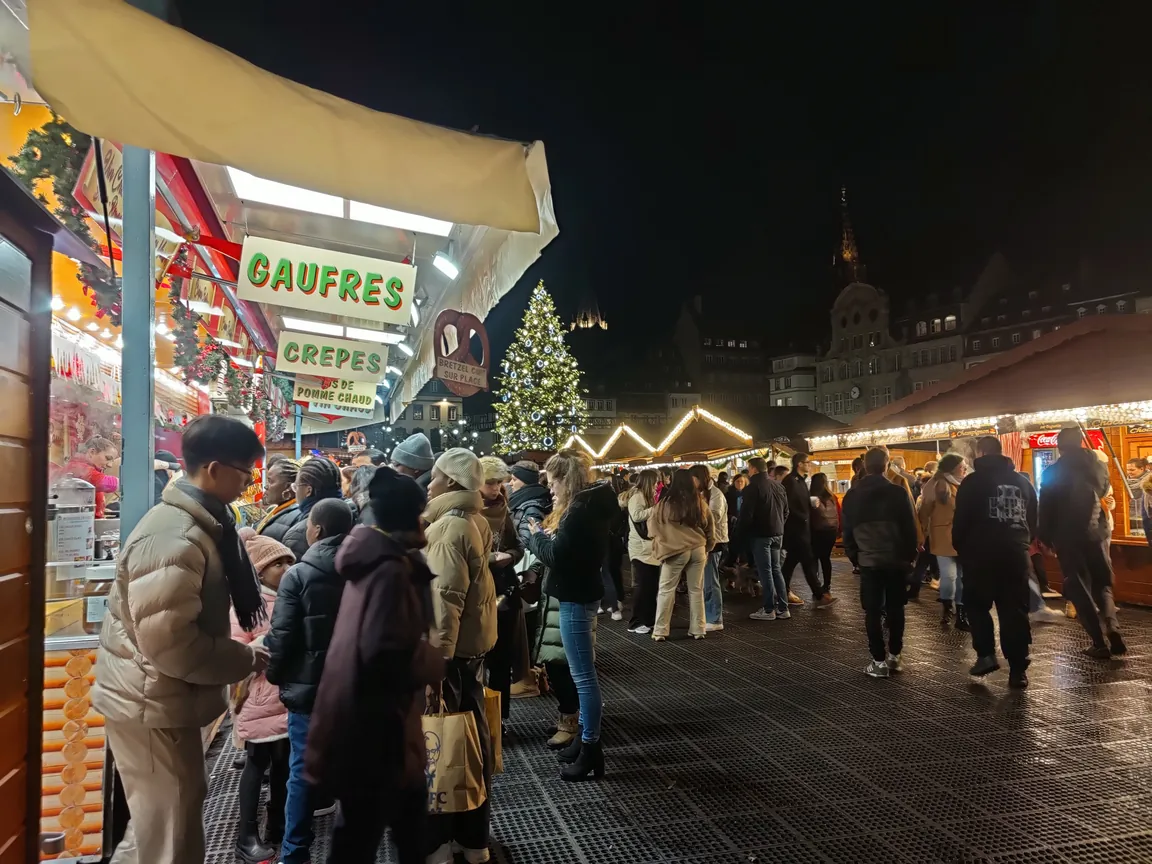
Late November and December: Christmas treats. Mannele are worth looking for around December 6, while cookies and mulled wine are on sale throughout the weeks before Christmas. The easiest place to find them is the Strasbourg Christmas market.
How to turn all this into one meal
If there are two of you, start with a flammekueche to share. Then try baeckeoffe or coq au riesling, but ask about portion size first: sometimes one main course is enough for two. If you still have room, finish with Munster or a fruit tart. Alsatian food is filling, so there is no need to order everything at once. Our guide to where to eat in Strasbourg will help you pick a restaurant and avoid the gap between lunch and dinner service.
Strasbourg with an audio guide
The TouringBee audio tour starts at the Pont Kuss, five minutes from the train station, runs through the whole historic center and ends at St Paul's Church. One of the stops is devoted entirely to Alsatian food, so you will know what to look for when it is time to eat. It is easy to pause the walk for a meal and carry on afterwards.
- 33 stops, about 2.5 hours at your own pace, recordings of 1–3 minutes.
- From €9.99, one-time payment, one year of access, 8 languages.
- Download the tour in advance, and the map and recordings will work without an internet connection.
- The map shows where you are, making it easy to find the next stop.
Ready to explore Strasbourg?
It is entirely possible to miss out on Strasbourg's food: stick to the familiar dishes you could order anywhere, and you will never find out what makes Alsatian cooking different. The alternative is to share a flammekueche, have a glass of Riesling and finally work up the courage for a piece of Munster. French and German traditions have shaped this food, but over the centuries Alsace has developed a food culture of its own. Baeckeoffe still carries a reminder of the old baker's ovens. Several centuries of Alsatian history on a single plate.
Frequently asked questions
What food is Strasbourg famous for?
Above all flammekueche, or tarte flambée, a thin flatbread with fresh cheese, onion and bacon. Just as famous are baeckeoffe, meat and potatoes slow-baked in a clay pot, and choucroute, sauerkraut with smoked meats.
How is flammekueche different from pizza?
The base is bread dough rolled much thinner, and it bakes for just a few minutes in a very hot oven. Instead of tomato and mozzarella, it is topped with fresh cheese and cream, raw onion and bacon.
Why is baeckeoffe called the "baker's oven"?
According to tradition, it was cooked in a baker's oven as it cooled down: families left the pot with the baker and collected it a few hours later. The strip of dough seals the dish and keeps the steam inside.
Is Alsace wine sweet?
Alsace makes plenty of dry whites, but sweetness depends on more than the grape. Many white AOC Alsace labels show the level of sweetness. Sec means dry. If you see demi-sec, the wine is off-dry. Sweeter styles are labeled moelleux and doux. In a restaurant you can always ask for a dry one.
Can vegetarians eat well in Strasbourg?
Yes, if you order carefully. Spätzle with cheese, flammekueche without bacon and fresh cheese with potatoes all work. Ask what the cabbage was cooked in and whether the onion tart contains bacon.
What food should I look for in December?
Brioche mannele around December 6, and bredele cookies and mulled wine at the Christmas markets.
Keep reading
- Strasbourg travel guide — the essentials about the city
- One day in Strasbourg — an hour-by-hour route with time for lunch
- The Strasbourg Christmas market — what the December chalets sell
- Petite France — the old tanners' quarter, now full of restaurants
- Strasbourg in winter — when this food feels most at home

Eugene has lived in France for 16 years and worked as a tour guide before founding the travel-content network paris10.travel. He wrote the TouringBee audio tour of Strasbourg.
Every price and opening time on this page is checked against the official source for the current year. Where a fact is not yet published, we say so instead of guessing.
TouringBee audio tours are our own product. Links to GetYourGuide and SNCF Connect are affiliate links. If you book through them, we may earn a small commission at no extra cost to you. These partnerships never influence our recommendations.