Still planning the whole trip? Start with our complete guide to Strasbourg, then come back here for the one-day details.
Most one-day itineraries are a list of places with no clock attached. Useless here. The city's most-photographed interior closes for ninety minutes in the middle of the day, its tower has no booking system at all, and the boat tickets sell out by lunchtime in summer. Timing is the whole game — which is why this day follows the shape of the TouringBee self-guided audio tour of Strasbourg. That route starts at Pont Kuss, five minutes from the train station, and ends at the cathedral. Arrive, walk, stand under the spire in time for the clock.
The scale helps. The Grande Île — the island the Ill wraps around, and the first whole city centre ever put on the UNESCO list instead of a single monument — is about a kilometre across. Fifteen minutes to cross. Nothing below needs a taxi, a bus or a tram, and the walking is flat.
At a glance
- Grande Île — about 1 km across; the full day is roughly 6–7 km on foot
- Cathedral nave — free. Mon–Sat 08:30–11:15 and 12:45–17:45. Sun and feast days 14:00–17:15 only
- Astronomical clock — film from 12:00, apostles at 12:30. €3 adult / €2 reduced. Entry from 11:30, Saint-Michel door. Same day only
- Platform climb — 330 steps to 66 m. €10 adult / €6 reduced. On-site sale only, no queue system
- Batorama boat — Circuit Rouge 1 h 10, €16.20 adult. Tickets are timed. Buy in the morning
- Museums — €7.50 each, 1-day pass €16. Closed Mondays. Musée Alsacien shut until 1 June 2028
- Paris → Strasbourg — direct high-speed trains, fastest 1 h 45
- Strasbourg City Card — €5 online. A discount card, not a pass, but it repays itself on the first attraction
The one thing that decides your day: 12:30
The astronomical clock stands in the south transept. Its full performance — apostles parading, the rooster crowing for Peter's denials, the carts of the ancient gods rolling out — runs once a day at 12:30, when astronomical noon arrives on the dial. A film precedes it from 12:00. To let the audience gather, the cathedral closes the nave to everyone else from 11:15 to 12:45.
That one fact reshapes a one-day visit. Plan to pop in around noon and you find shut doors and a slightly smug crowd queueing at a different entrance.
That entrance is Saint-Michel, off Place du Château, open from 11:30. Tickets are €3 adult, €2 reduced, free under 6 — sold at the cathedral shops until 11:00, then at the door. There is no advance booking, anywhere, for anyone. A site offering a "skip-the-line astronomical clock ticket" is selling something that does not exist. No show on Sundays or church holidays with an 11:00 mass, when access is free after that mass; on Sundays the nave itself opens only at 14:00.
The platform is the opposite trap. No timed entry, no reservation, no queue system — you climb when you arrive, and so does everyone else. The queue is purely a function of the hour. Go right after opening, or in the last two hours of the day. Never 15:00 on a July Saturday.
Cannot be pre-booked at all: the 12:30 clock show and the platform climb. Both are on-site, same-day sales.
Book early on the day: Batorama. Tickets are timed and slots go hours ahead.
Worth five euros: the Strasbourg City Card, from the tourist office on Place de la Cathédrale. €5 online, €6 at the counter, valid 7 days: minus €4 on the platform, €4 per museum, €3.14 on Batorama. Guided extras sit among the tours and cruises in Strasbourg.
08:30 — Off the train, onto Pont Kuss
Leave your bag at the station's left luggage, walk out from under the glass bubble covering the 1883 hall, and head east on Rue du Maire Kuss. Five minutes later you are on Pont Kuss, over the Ill, where the audio route begins.
Start walking straight away. The classic mistake is a leisurely 09:00 coffee — you will want that hour back at 16:00. Have it on a bench in Petite France instead.
09:00 — Grande Rue, the oldest street in the city
Ten minutes on foot brings you to Grande Rue, laid over a Roman military road in the 5th century, lined now with houses from the 16th to the 19th. At Old Saint Peter's a Protestant and a Catholic church share one roof with separate doors each.
Learn the half-timbering trick before you photograph two hundred examples of it. Medieval property tax was calculated on the footprint at ground level. So builders pushed each upper floor further out over the street and paid tax on the smallest slice of the house. Every overhanging facade in this city is a 500-year-old tax dodge.
09:45 — Petite France and the best free view in Strasbourg
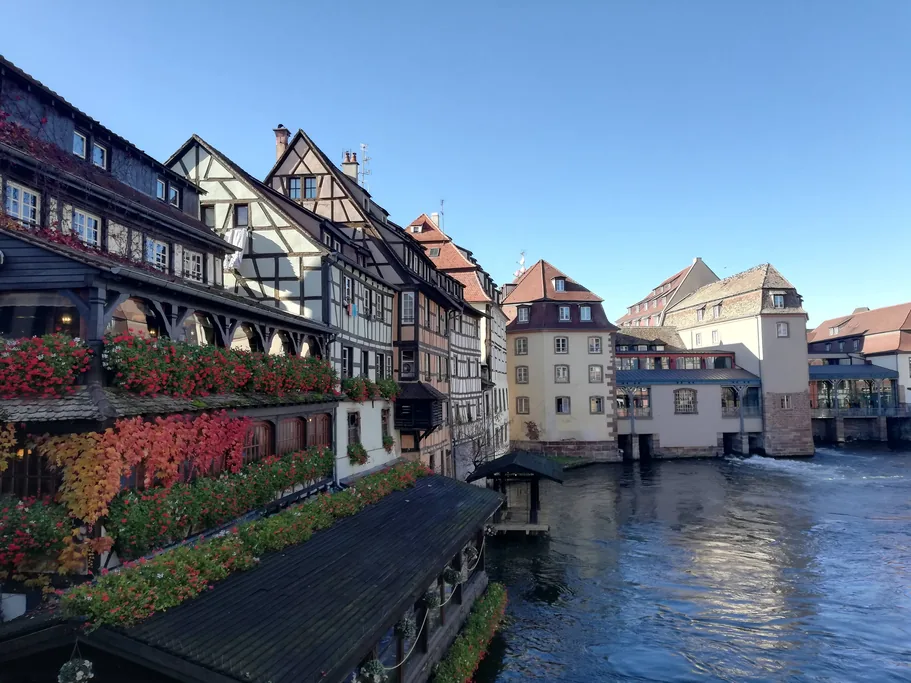
Cross the Faisan Bridge — a swing bridge that pivots, supposedly, like a pheasant's mating dance — and you are in Petite France, fifteen minutes from Grande Rue.
The name is not romantic. A late-15th-century hospice stood here for soldiers with syphilis, which German-speaking Strasbourg called "the French disease". Before the tourists this was the tanners', millers' and fishermen's quarter, and those open attic storeys were not built for the view. Hides dried up there.
Keep west to the Ponts Couverts, four 13th-century towers left from a wall that once had ninety. They are called covered bridges because they had wooden roofs six centuries ago. The roofs went. The name stayed.
Then climb the Barrage Vauban opposite. Finished in 1688, it was a weapon: close its sluices and the Ill rises and floods the southern plain, which makes artillery useless. It worked once, in 1870. Up the stairs is a rooftop terrace, free, with the covered bridges in the foreground and the cathedral spire behind. The only better view in the city costs €10 and 330 steps.
Leave by 10:45.
11:15 — Cross the island to the cathedral
Vauban terrace to Place de la Cathédrale is about a kilometre, twenty-five minutes if you stop, and you will. You pass the Church of Saint Thomas, where Marshal Maurice de Saxe descends into his own white marble tomb, head high, a British leopard and an Austrian eagle collapsing at his feet; then Place Gutenberg, renamed in 1840 for the man who spent a decade here inventing movable type before taking it home to Mainz.
Turn into Rue Mercière. The cathedral fills the end of it like a stage set. That is the photograph. Then go straight to the Saint-Michel entrance and buy your €3 ticket. Doors from 11:30.
12:30 — The apostles, then the nave to yourself
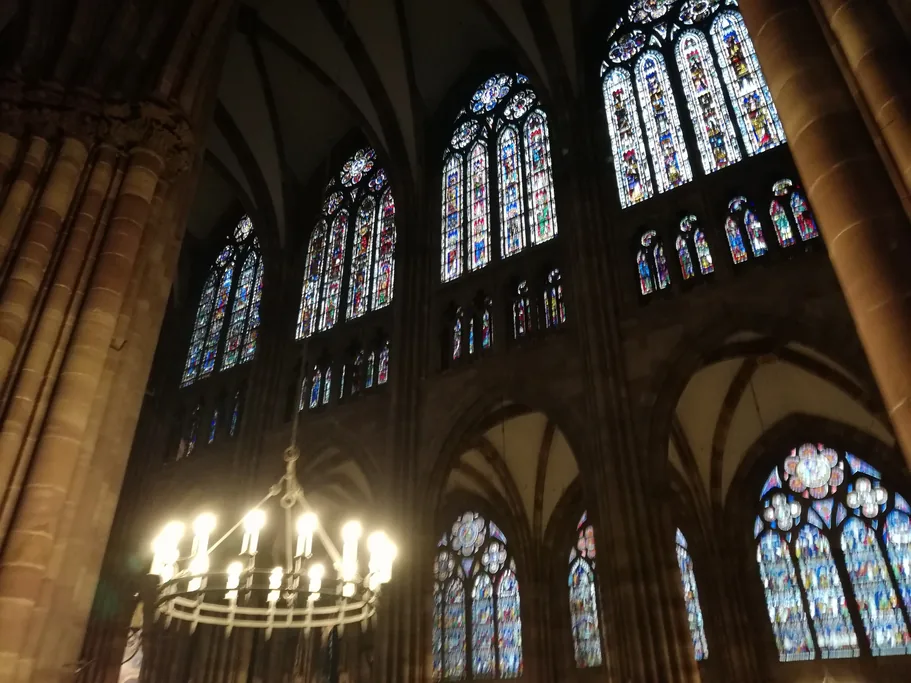
Look up before the show. The medieval stained glass here is second in France only to Chartres, and it survived the war in wooden crates — some seized by the Germans and hidden in Austrian salt mines, later found by American soldiers who read the labels and sent them home.
At 12:00 the film runs. At 12:30 the machine wakes: an angel rings, another turns the hourglass, the ages of man file past Death, Christ drives Death back, the apostles kneel, the rooster crows three times.
Then the reward nobody mentions. At 12:45 the nave reopens to everyone — and you are already inside it while the rest of the city is walking over. Twenty quiet minutes under 32-metre vaults.
Out of the west door, look up once more. 142 metres, one spire, finished by Johann Hültz in 1439. The south tower was never built. Nothing on earth was taller between 1647 and 1874.
13:15 — Lunch, and the Batorama warning
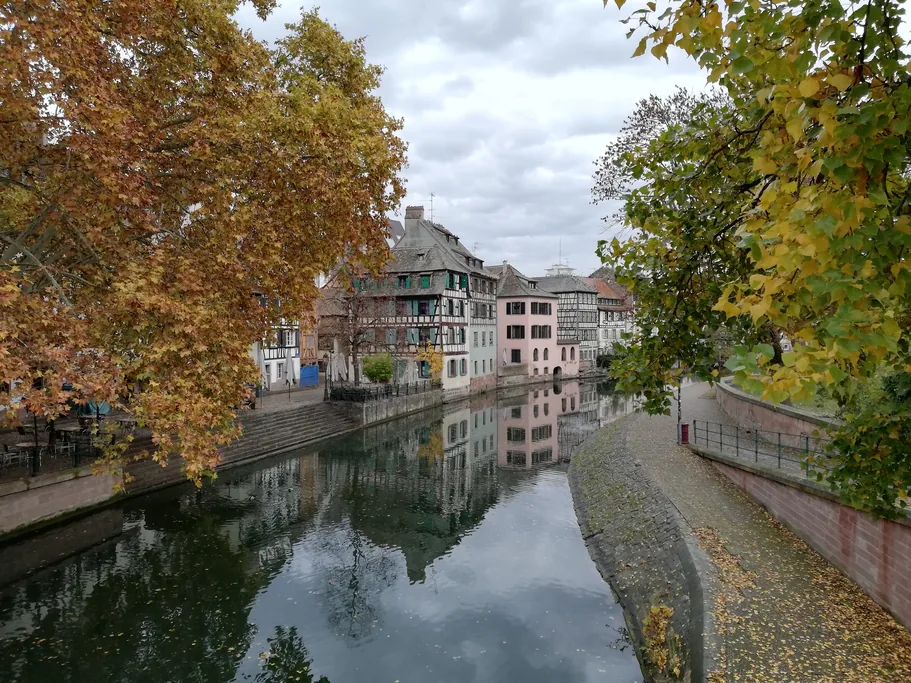
Strasbourg Boat Cruise on the Ill Timed entry
Do this in order: buy the boat ticket first, eat second.
Batorama's Circuit Rouge runs 1 h 10 around the Grande Île, through the locks and out to the European quarter — €16.20 adult, €14.70 for 13–17, €8.90 for 4–12. Board at Embarcadère Cathédrale, pontoon A only; B and C are out of service in 2026 — or at Quai au Sable, a hundred metres away. Tickets are timed. One reviewer nearly missed her train because the next free slot was two hours later. Buy now for an afternoon departure, then go and eat.
The shortest walk is back to Rue des Moulins in Petite France, where practically every door is a restaurant. Or stay by the cathedral and eat inside the Kammerzell House — 1427 in its bones, 1589 in its carved facade, seventy-five windows and frescoed rooms.
Order the regional things. Tarte flambée: paper-thin dough, fromage blanc, onion, bacon, blasted in a hot oven. Baeckeoffe: three marinated meats layered with potato in a sealed clay terrine, named "the baker's oven" because families dropped it at the bakery on the way to Sunday service. Drink Riesling or Pinot Gris — Alsace names its wines after the grape, not the village.
14:30 — Palaces, museums, the slower half of the island
The flexible block. Three options, and you will fit one and a half.
Palais Rohan, the 18th-century bishop's palace where Louis XV, Marie-Antoinette and Napoleon all slept, holds three separate museums — Fine Arts, Decorative Arts, Archaeology — at €7.50 each, or the €16 day pass, which is the obvious move past two. Everything municipal is closed Mondays, free for all on the first Sunday of the month, always free under 18, and sold at the desk only.
Across the water the Historical Museum occupies the city's Renaissance slaughterhouse of 1588 and holds the scale models that make the whole island legible. The Musée Alsacien is closed for renovation until 1 June 2028 — do not walk there.
Not a museum person? Take the quiet loop instead: Raven Bridge, where the condemned were lowered into the river in willow cages, then the Milk Pig Market Square with its shoe-shaped weathervane.
16:30 — 330 steps, or an hour on the water
Strasbourg Self-Guided Audio Tour Instant access
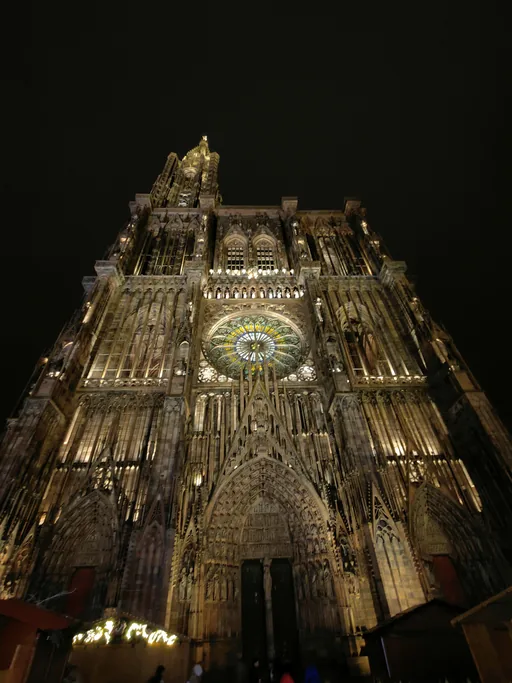
Now the platform. The queue has thinned and the pink Vosges sandstone turns warm as the sun drops — that colour is iron oxide in the stone.
330 steps, no lift, 66 metres up, €10 adult and €6 reduced. From 1 April to 30 September, 09:30–13:00 and 13:30–20:00, last ascent 19:15. From 1 October to 31 March, 10:00–13:00 and 13:30–18:00, last ascent 17:15. Note the midday break: the tower shuts 13:00–13:30 all year. Closed 1 January, 1 May, 25 December.
If your knees vote against it, this is when the boat you booked at lunchtime leaves instead.
18:30 — West across the island, then dinner
Use the last of the light. Place Kléber is the biggest square in the city and holds the Christmas tree. Place Broglie is really a boulevard, and it is where the Marseillaise was first performed in 1792. Cross the Jewish Bridge to Place de la République, where a 1936 monument shows a Strasbourg mother holding two dying sons — one who fought for France, one for Germany, reaching for each other's hands. The inscription reads only "Our Fallen". No country is named. In a city that changed hands in 1681, 1871, 1918, 1940 and 1944, nothing else would have been accepted.
Then double back to Petite France for dinner in a winstub — checked tablecloths, wine in glasses with bright green stems, a format invented by winemakers selling their own surplus alongside home cooking.
Two variations: the first TGV from Paris, and a wet day
Coming from Paris that morning. Direct high-speed trains leave Gare de l'Est; the fastest covers the 440 km in 1 h 45 — check times and fares here. The fare swings hard with the date: booked ahead it can drop under €30, close to the day it climbs well above that. On the first fast departure you reach Pont Kuss around 09:30 instead of 08:30. Take that hour out of the afternoon, not the morning: compress Petite France, keep the 11:30 clock entry exactly as written, drop to one museum, and swap the tower for the boat if you have an evening train back. The station is ten minutes' walk from Petite France, so leaving the island at 20:30 still makes a 20:45 departure.
If it rains. Most of the highlights have a roof. Do the clock at 12:30 as planned, stay in the nave until 13:30, eat under the beams at Kammerzell, then run Palais Rohan's three museums on the €16 day pass and finish at the Historical Museum. That is the whole afternoon indoors. Batorama boats are covered and run all year, so the 45-minute Circuit Bleu at €12.50 is a dry hour too. Skip the platform — 330 wet steps to a view of cloud is nobody's idea of fun.
The audio guide
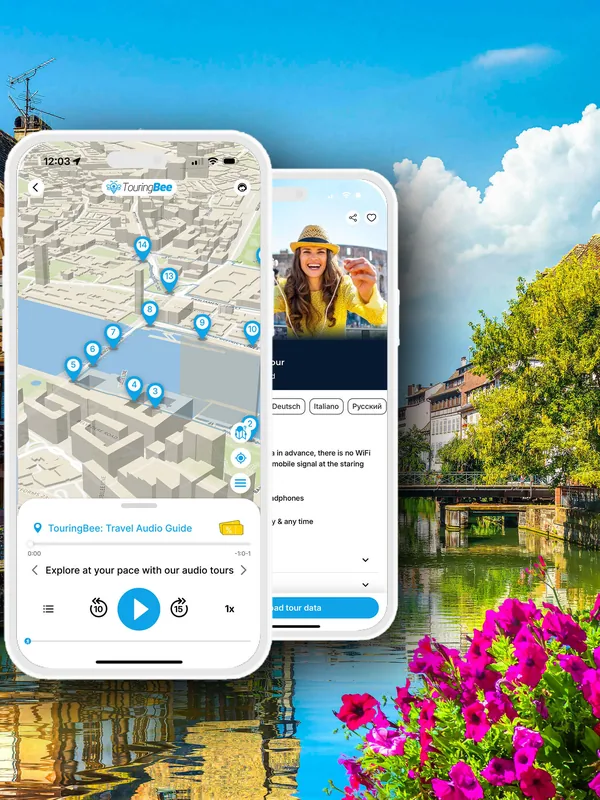
The TouringBee City Tour of Strasbourg is a self-guided audio walk in the TouringBee app, iOS and Android. 33 stops, about 2.5 hours at your own pace — roughly 90 minutes of audio, each recording one to three minutes. It starts at Pont Kuss and ends at the cathedral: the same arc as the day above.
From €9.99, one payment, one year of access, no subscription, activation email in three to five minutes. Once downloaded it works fully offline. Eight languages: English, French, German, Spanish, Italian, Portuguese, Polish, Russian.
How the map works: the app shows an offline GPS map with your position on it, so you always know where the next stop is. It does not play audio by itself. You press play when you reach each stop. That is the point — break for lunch and pick the tour up two hours later exactly where you left it.
"Wonderful way to see all the city on your own… if you want to do a river cruise, get your tickets early in the day. They are timed."
— Julia_P, GetYourGuide, August 2025
Rated 5.0 from 7 verified reviews on Viator and GetYourGuide.
Get the Strasbourg audio tour — from €9.99
Ready to walk it?
Be on Pont Kuss at 08:30 and the rest of the day builds itself.
Frequently asked questions
Is one day enough for Strasbourg?
For the Grande Île, yes. The UNESCO centre is about a kilometre across, so Petite France, the covered bridges, the cathedral and the main squares fit into one day on foot. One day will not cover the European quarter, a museum run and a trip to Colmar as well.
What time does the Strasbourg astronomical clock strike?
The full performance runs once a day at 12:30, with a film from 12:00. Entry is through the Saint-Michel door off Place du Château from 11:30; tickets are €3 adult, €2 reduced. It does not run on Sundays or church holidays with an 11:00 mass, when access is free after that mass.
Can I book cathedral clock or tower tickets in advance?
No. Both are sold on site, same day only. The €3 clock ticket comes from the cathedral shops until 11:00 or the Saint-Michel door from 11:30; the €10 platform ticket is sold at the tower. No skip-the-line ticket exists for either, from any operator.
Is Strasbourg Cathedral closed in the middle of the day?
Yes. The nave closes 11:15–12:45 Monday to Saturday for the astronomical clock. Otherwise it is free to enter, 08:30–11:15 and 12:45–17:45. On Sundays and feast days it opens only 14:00–17:15, and it may close during services.
Do I need to book the Batorama boat tour?
Book it early on the day you sail. Tickets carry a fixed departure time and slots sell out hours ahead in high season. The Circuit Rouge lasts 1 h 10 and costs €16.20 adult. Board at Embarcadère Cathédrale, pontoon A — pontoons B and C are out of service in 2026.
Can I visit Strasbourg as a day trip from Paris?
Yes. Direct high-speed trains run from Gare de l'Est and the fastest takes 1 h 45. Take the first fast train, walk five minutes from the station to Pont Kuss, and you will still make the 12:30 clock comfortably.
Which day of the week is worst for a one-day visit?
Monday, when every municipal museum is closed, and Sunday, when the nave opens only at 14:00 and the clock show may not run. Tuesday to Saturday gives you the full itinerary.
Continue exploring
- Complete guide to Strasbourg — where to stay, when to come, what it all costs
- Strasbourg walking tour — the 33-stop route in full, stop by stop
- Strasbourg Cathedral — clock, platform and opening hours in one place
- What to eat in Strasbourg — tarte flambée, baeckeoffe, and how a winstub works
- How many days in Strasbourg? — if one day is starting to feel tight

Eugene has lived in France for 16 years and worked as a tour guide before founding the travel-content network paris10.travel. He wrote the TouringBee audio tour of Strasbourg.
Every price and opening time on this page is checked against the official source for the current year. Where a fact is not yet published, we say so instead of guessing.
Some links on this page are affiliate links (GetYourGuide, Booking.com, SNCF). If you book through them we may earn a small commission at no extra cost to you. It never affects what we recommend.