Strasbourg's German past is about much more than half a century under the Kaiser. For centuries before that, the city ran its own affairs inside the Holy Roman Empire: it traded, built a cathedral and quarrelled with its bishops. Then came a French king, after him a German emperor, and the 20th century added a few more changes of flag. So why, after all that, didn't Strasbourg simply become a French city with German houses?
Strasbourg Self-Guided Audio Tour Instant access
The short answer: today Strasbourg is French, but its character is Alsatian, with its own culture and language. You don't need a museum to notice it, just keep your eyes open. The TouringBee audio tour brings the old streets to life, from medieval punishments and curious local customs to the legends of the cathedral.
At a glance
| Key facts | |
|---|---|
| Age | Over 2,000 years: a Celtic settlement, then the Roman camp of Argentoratum |
| Free city of the Holy Roman Empire | From 1262, more than four centuries of self-government |
| The Oaths of Strasbourg | 842, one of the oldest texts in Old French |
| Cathedral spire | 142 m, the tallest building in the world from 1647 to 1874 |
| European capital | Council of Europe since 1949, one of the three capitals of the EU |
The timeline makes one thing clear: Strasbourg's history is much more complicated than a simple tug-of-war between France and Germany. The city spent 47 years under the German Empire, nearly two centuries under French rule before that, and far longer governing itself.
- 1262–1681. Free city of the Holy Roman Empire, 419 years.
- 1681–1871. France, 190 years.
- 1871–1918. German Empire, 47 years.
- 1918–1940. France, 22 years.
- 1940–1944. Nazi occupation and de facto annexation, 4 years.
- Since 1944. France, more than 80 years.
Argentoratum: why the Romans chose this spot
Picture an island among river channels. Near the Rhine, the River Ill splits into several arms, creating an island that was easier to defend than the land around it. A place like that is also handy for keeping an eye on who is heading to the Rhine and with what goods. The Romans saw this as early as the 1st century BC and set up a military camp here, Argentoratum.
The most curious part is that the line of one of the Roman roads can still be traced. Grand'Rue, the city's oldest street, follows it. You can stroll along it from shop window to shop window without suspecting how old the route is. The German name of the city keeps the same idea: Strassburg means "fortress on the road".
842: oaths written in a language that looks like French
Two grandsons of Charlemagne, Charles the Bald and Louis the German, decided to team up against the third, their brother Lothair. An ordinary medieval family feud, except for one oddity: each ally swore his oath in the language of the other's soldiers.
Charles spoke in a Germanic dialect, Louis in the Romance tongue of the western Franks. Not out of politeness: the soldiers had to understand exactly what they were being promised.
The chronicler Nithard recorded both oaths, giving us one of the earliest surviving examples of the Romance language that would eventually become French. And it was written down here, in a city whose name and houses strike many people as rather German.
What the oath sounded like. Louis's Romance oath begins with the words Pro Deo amur et pro christian poblo et nostro commun salvament, "For the love of God and for the Christian people and our common salvation". Some of the words may look faintly familiar to French speakers, but this is a long way from modern French.
1262: four centuries of self-government
Today we think of a bishop as a religious leader. In medieval Strasbourg, though, the bishop also ruled the city. And the wealthy townspeople were growing tired of having someone else make decisions for them.
The dispute turned into open war, and the townspeople won. Strasbourg became a free city of the Holy Roman Empire: on paper a distant emperor still stood above it, but the city managed its own business. It stayed that way for more than four centuries.
Strasbourg's merchants wanted their city to be taken seriously. And what better way to show its wealth and ambition than a magnificent cathedral? Construction had begun under the bishops, long before the city won its independence, but generations of citizens helped shape the cathedral we see today. The spire of Strasbourg Cathedral was completed in 1439, rising 142 metres above Cathedral Square. For more than two centuries it was the tallest building in the world. Imagine that towering above a medieval city where most houses were only a few storeys high.
Now look at the façade: there is only one tower. The second was never built, and that very asymmetry is what makes the cathedral recognisable from afar.
Gutenberg's decade and a Protestant city in a Catholic empire
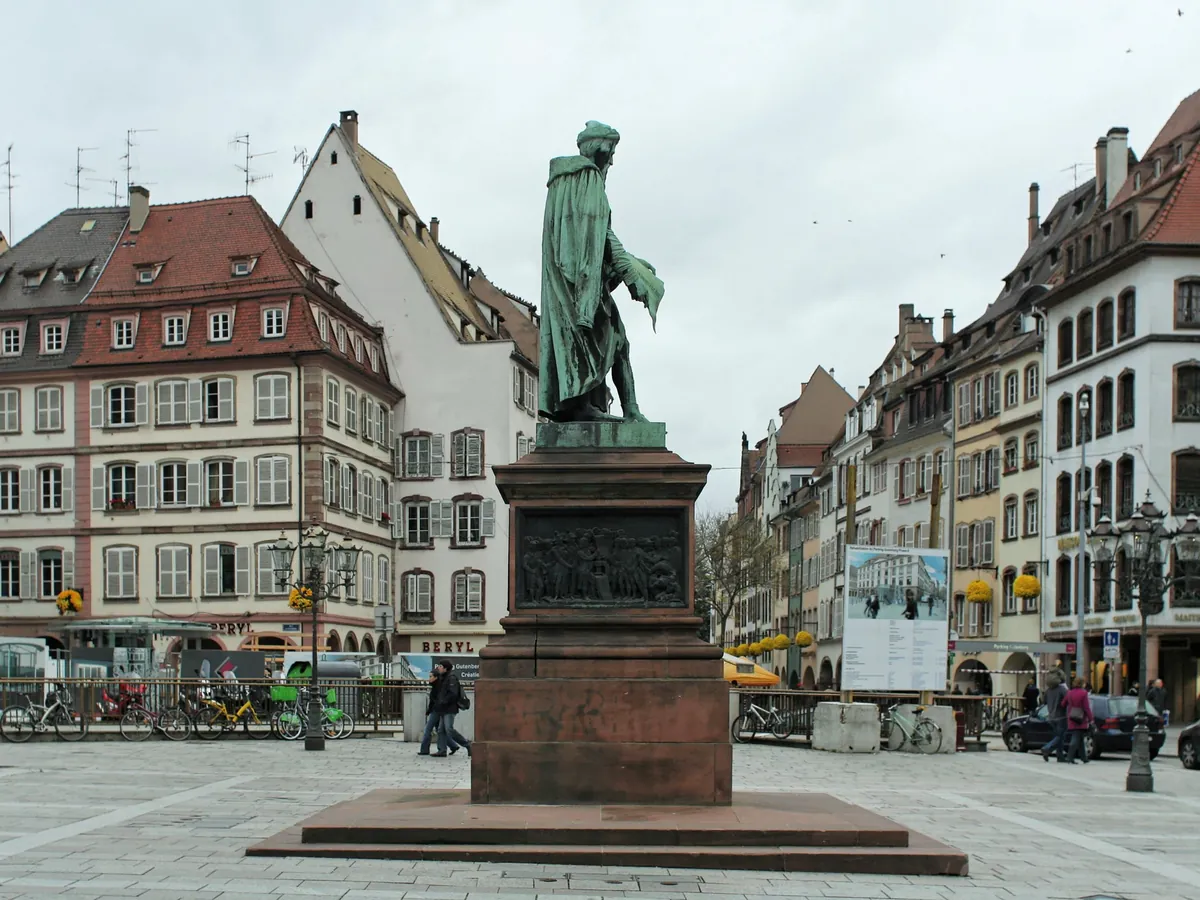
On Place Gutenberg stands a monument to a man without whom European history would have gone differently. Yet he did his life's great work elsewhere. From about 1434 to 1444 Gutenberg lived in Strasbourg, working on technical ideas that may have helped him develop his printing methods. His famous Bible was printed later, in Mainz.
A story you'll hear on the route. According to local lore, the words on the Bible page in Gutenberg's hands changed as Strasbourg passed between French and German rule. The TouringBee audio tour tells that story right here, in front of the monument.
So why does he matter so much to Strasbourg? Printed books and pamphlets changed the way ideas spread. Theological debates had once stayed within a narrow circle, and now new views reached neighbouring cities within weeks.
By the 1520s Strasbourg had become an important centre of the Reformation. The city embraced Protestantism while remaining part of the Holy Roman Empire, creating religious tensions that would shape Strasbourg for generations. Reformers who were no longer safe at home found refuge here. The traces of that split are still visible: St Thomas' Church became the city's main Protestant church, and at Saint-Pierre-le-Vieux a Catholic and a Protestant church stand under one roof, each with its own entrance.
The summer Strasbourg couldn't stop dancing
Before the Reformation took hold, Strasbourg had already lived through one of the strangest episodes in its history. In the summer of 1518, dozens of residents began dancing and apparently couldn't stop. The city council called in physicians, while later accounts claim the authorities even hired musicians to keep the dancers going. What was really happening? Historians are still arguing about it.
1681 and 1792: Louis XIV, and then the Marseillaise
1681: a French king, a Protestant city
In the autumn a French army appeared outside the city walls, and Louis XIV made Strasbourg an offer it couldn't refuse. The city surrendered without a fight, and four centuries of self-government ended within a few days.
But becoming French on paper and giving up the old ways of life are two different things. The city's Protestants were allowed to keep their Lutheran churches, although the cathedral itself was returned to Catholic worship. For Louis XIV, who was steadily stripping Protestants of their rights across the rest of France, this was a rare compromise.
Then France set about making the city look French too. In the late 17th century Vauban blocked the southern approach with a dam that could flood the plain on command. And the bishops of the Rohan family, appointed by the king, built the Palais Rohan next to the cathedral in the 1730s, in pure Parisian Baroque.
1792: how the Marseillaise was written in Strasbourg
The Marseillaise wasn't written in Marseille at all. In the spring of 1792 the mayor of Strasbourg, Philippe-Frédéric de Dietrich, asked the military engineer Rouget de Lisle to compose a marching song for the army. He wrote it in a single night, and on 26 April it was sung for the first time in the mayor's salon. Volunteers from Marseille carried the song to Paris, and it took the name of their city.
And here's the irony: one of France's greatest national symbols was born in a city that had been under French rule for just over a century. Yet Strasbourg still had several changes of flag ahead of it.
1871–1918: the Germans built a second Strasbourg
For Strasbourg the Franco-Prussian War began with the siege of 1870, and the bombardment burned down the city library. After France's defeat, Alsace and part of Lorraine passed to the German Empire, and for 47 years Strasbourg was the capital of an imperial territory.
The new rulers decided to show that this was now an important German city, and began building a whole new district next to the old one: the Neustadt, the New Town. The difference is easy to see. Around the cathedral there are narrow streets, houses pressed against each other and small squares. In the Neustadt there are wide avenues, huge stone buildings and a sense of space the medieval town never had.
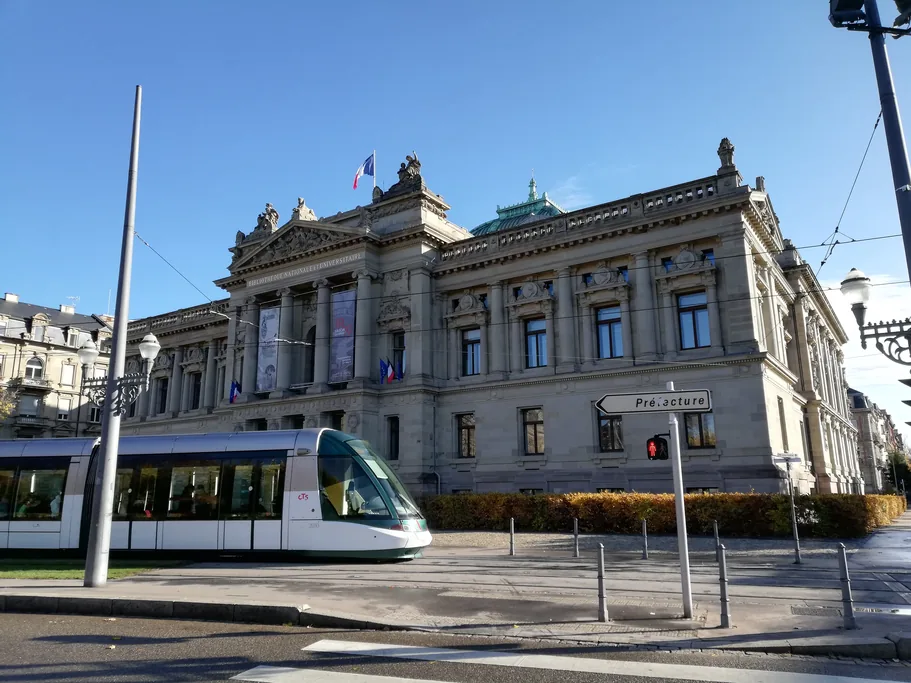
To see the contrast for yourself, walk from the cathedral to Place de la République, the former Kaiserplatz. It takes about a quarter of an hour. The streets suddenly open out onto a broad square surrounded by monumental buildings, and Strasbourg feels less like a medieval trading town and more like an imperial capital. Its centrepiece is the Palais du Rhin, built as a residence for the German Emperor, who only ever stayed there on short visits. Next to it stand the university library and the former parliament of Alsace-Lorraine. The empire showed its power not with words but with an entire district.
In fact, you may have seen a piece of German-era Strasbourg before you even reached the old town. The railway station dates from 1883, when the city belonged to the German Empire. Today its historic façade sits behind a huge curved glass shell. From outside, the station looks thoroughly modern, until you spot the older building within.
1918, 1940, 1944: three changes in twenty-six years
On Place de la République, the building that once housed the parliament of German-ruled Alsace-Lorraine later became a conservatoire. After the First World War Strasbourg was French again, and the halls that had hosted political debates began filling with music.
It's a very Strasbourg kind of transformation: the building stayed put, but its purpose changed along with the rulers.
The next change of power, though, was far darker. Nazi Germany occupied Alsace and annexed it in all but name. The new authorities set about purging French from public life: place names, shop signs, schools, even berets. The Great Synagogue on Quai Kléber, built in 1898, was looted and burned in the autumn of 1940, and its remains were destroyed in 1941.
From 1942 the Nazi authorities began forcibly conscripting young Alsatians into the Wehrmacht. Tens of thousands of men ended up in the German army, and many were sent to the Eastern Front. Their families stayed at home under the rule of the same people who had taken their sons and husbands, and refusing to serve could bring reprisals on the whole family. These forcibly conscripted Alsatians are called the malgré-nous, "against our will". Many of them died in Soviet captivity.
For many Alsatian families, the question of whether their relatives were French or German is not an abstract historical debate. It is part of their family history.
In November 1944 the city was liberated by General Leclerc's 2nd Armoured Division. Back in the Libyan desert his soldiers had sworn not to stop until the French flag flew over the cathedral again. Leclerc's monument stands on Place Broglie.
1949: why Europe chose the most contested ground in the West
After the Second World War, Strasbourg took on an unexpected new role. The city that France and Germany had fought over for generations became a place where European countries could work together instead of fighting over borders.
The Council of Europe set up its headquarters here, the European Court of Human Rights followed, and Strasbourg later became the official seat of the European Parliament's plenary sessions. The glass buildings of the European Quarter aren't just a modern addition to the old city. They're the latest chapter in its long and complicated history.
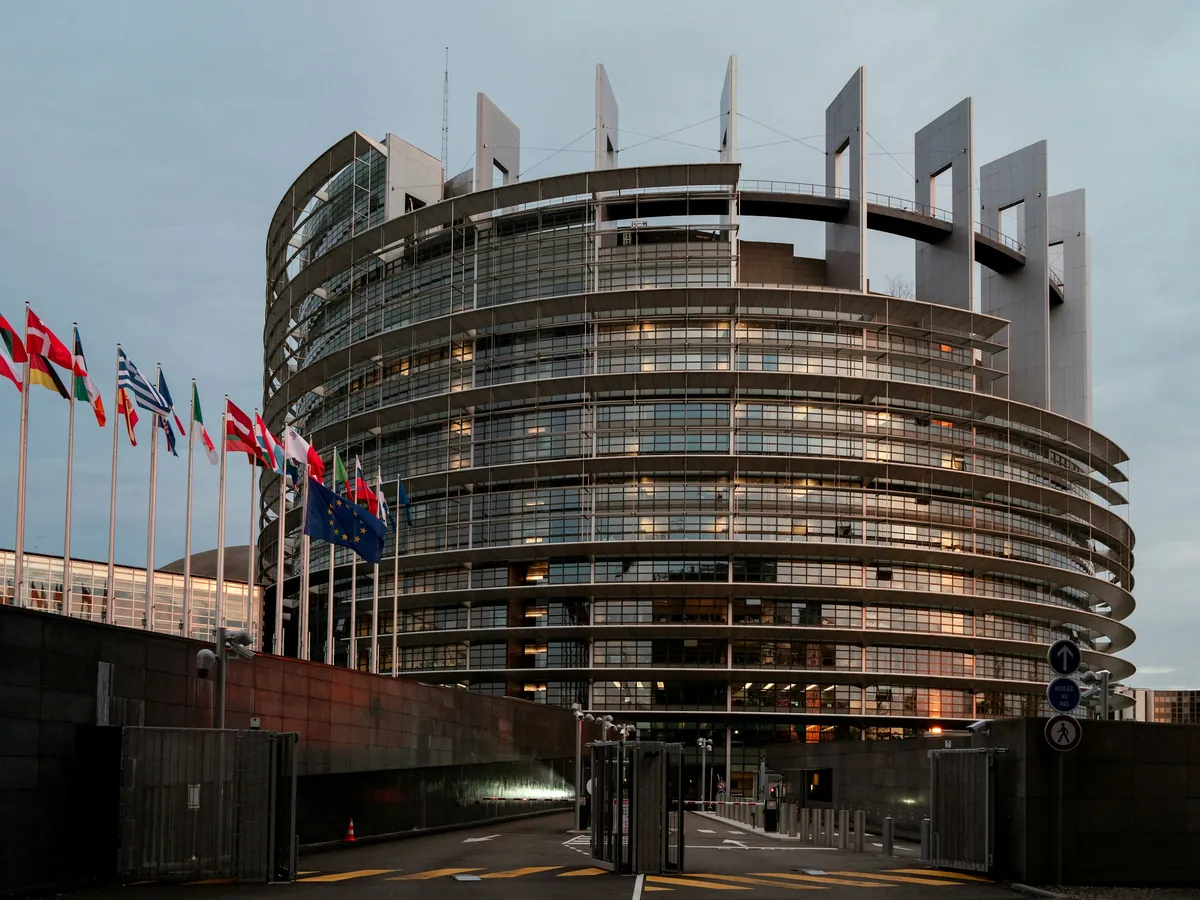
You can also visit the European Parliament for free. Just remember to bring your original passport or national identity card.
Which language is spoken here
People in the street will most likely talk to you in French. But look closely at the street signs in the old town: under the French name there is often a second one, in Alsatian.
Alsatian is a group of Germanic dialects rather than a form of French. To an unfamiliar listener it may sound a lot like German, but it has its own local traditions and has been influenced by French over the centuries. For generations it was the language of homes, markets and everyday conversation.
Alsatian is less widely spoken today. After the two world wars, anything that sounded German became politically sensitive, and schools encouraged children to speak French. Yet the old Alsatian street names survive, a small reminder that the city's identity is more complicated than a choice between two countries.
Where to see each era
You don't have to travel far to see Strasbourg's history. Most of its defining moments have left traces within walking distance of the cathedral.
| Era | Where to see it |
|---|---|
| Roman Argentoratum | Grand'Rue, laid along the line of a Roman road |
| The free city | The cathedral with its single tower |
| Gutenberg and the Reformation | Place Gutenberg, St Thomas' Church, Saint-Pierre-le-Vieux |
| French 17th–18th century | The Barrage Vauban and the Palais Rohan |
| German Empire | Place de la République with the Palais du Rhin, the station behind its glass |
| 20th century | The war memorial on Place de la République, the Leclerc monument on Place Broglie |
| European capital | The European Quarter |
Almost all of this, apart from the station and the European Quarter, lies on the route of the audio tour. And if you'd rather explore these places with a live guide, you can join one of the guided tours of Strasbourg.
Strasbourg with an audio guide
Explore Strasbourg's old town at your own pace, with stories that bring its streets, buildings and people to life. The TouringBee audio tour takes you from Pont Kuss through the historic centre to St Paul's Church. Stop for coffee, take a detour and pick up the tour whenever you're ready.
- 33 stops, about 2.5 hours.
- The map and recordings work offline.
- From €9.99, one-time payment, one year of access.
Ready to explore Strasbourg?
No regime ever managed to erase the traces of the one before. The Roman road became a shopping street, the free city's cathedral outlived kings and emperors, and French and European flags now fly beside buildings originally put up for the German imperial administration. Strasbourg doesn't choose between its eras. It lives in all of them at once.
Frequently asked questions
Is Strasbourg French or German?
Today Strasbourg is a French city. But its history is more complicated: for several centuries it was a free city of the Holy Roman Empire, and later it passed between France and Germany more than once. That is why both French and Germanic traditions survive here, while the local culture remains Alsatian.
Why does Strasbourg look German?
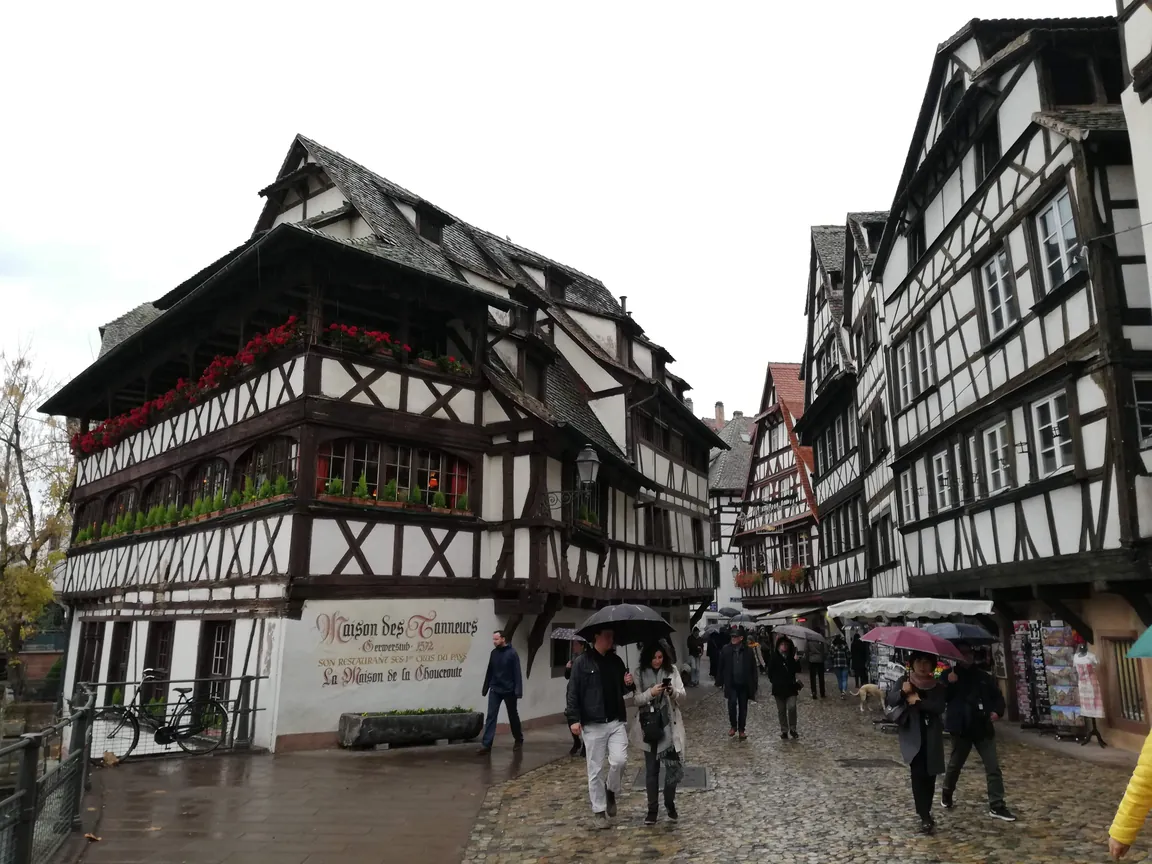
The half-timbered houses belong to the Germanic building tradition of the centuries when Strasbourg was a free city of the Holy Roman Empire. And the Neustadt district north-east of the old island was built by the German Empire after 1871, deliberately on an imperial scale.
What happened to Strasbourg in the Second World War?
In 1940 Nazi Germany occupied Alsace and annexed it in all but name, pushing out the French language. From 1942 Alsatians were conscripted into the Wehrmacht. They are called the malgré-nous, "against our will", and many died on the Eastern Front or in Soviet captivity. In November 1944 the city was liberated by Leclerc's division.
Why is the European Parliament in Strasbourg?
After the Second World War Strasbourg became a symbol of reconciliation between France and Germany. That is why the Council of Europe was based here, followed later by the European Parliament. A city once fought over became a place of political cooperation.
Do people in Strasbourg speak German?
Most people in Strasbourg speak French in everyday life. The traditional local language, Alsatian, is a Germanic dialect, and young people speak it less and less. Street signs in the old town show both names.
Read next
- Strasbourg travel guide — the essentials about the city
- Strasbourg Old Town — the island where all this happened
- Strasbourg Cathedral — what the free city spent centuries on
- Why Strasbourg is the Capital of Christmas — how the Reformation changed the December market
- One day in Strasbourg — the same places, hour by hour
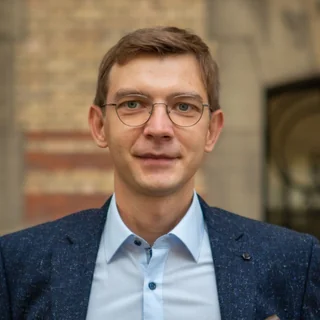
Eugene has lived in France for 16 years and worked as a tour guide before founding the travel-content network paris10.travel. He wrote the TouringBee audio tour of Strasbourg.
Every price and opening time on this page is checked against the official source for the current year. Where a fact is not yet published, we say so instead of guessing.
TouringBee audio tours are our own product. The link to GetYourGuide tours is an affiliate link. If you book through it, we may earn a small commission at no extra cost to you. These partnerships never influence our recommendations.