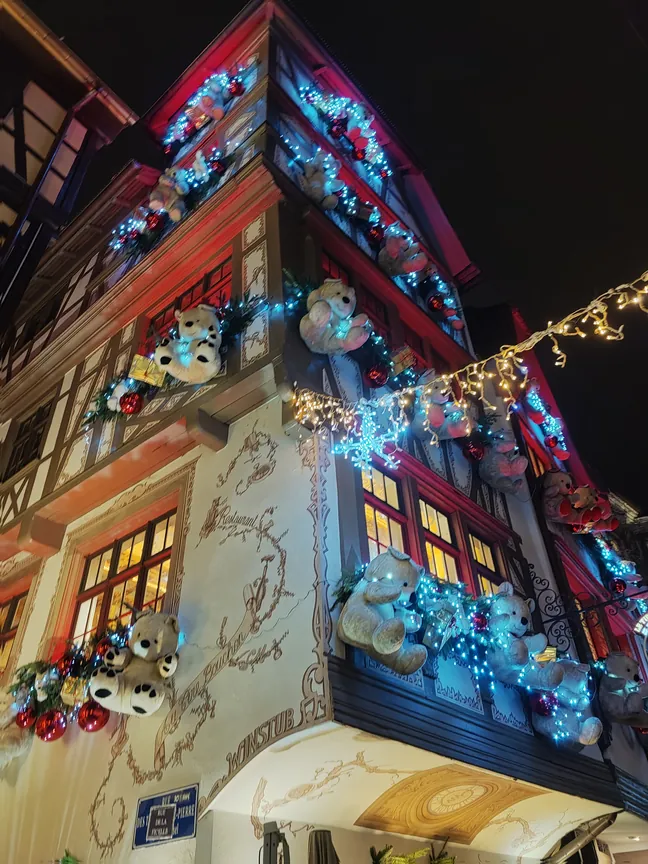
The difference shows in how each market fits into its city. In Nuremberg, it's a little town of identical wooden stalls. In Vienna, it's the square in front of a neo-Gothic city hall. In Zurich, it's the hall of the main train station, safe from the rain, and in the Alsatian villages, it's a couple of streets lined with half-timbered houses.
In Strasbourg, the Christmas stalls are spread over a dozen squares in the old center, and you walk from one to the next. By day, you can explore that same center with the TouringBee audio tour, then head back to the stalls in the evening.
At a glance
2026 dates of the main markets
| City | Main market | 2026 dates |
|---|---|---|
| Strasbourg | Christkindelsmärik, Place Broglie | November 27 – December 24 |
| Colmar | Place des Dominicains market | November 23 – December 29 |
| Cologne | Cathedral market, Roncalliplatz | November 16 – December 23 |
| Nuremberg | Christkindlesmarkt, Hauptmarkt | November 27 – December 24 |
| Vienna | Christkindlmarkt, Rathausplatz | November 13 – December 26 |
| Prague | Old Town Square market | November 28, 2026 – January 6, 2027 |
| Budapest | Advent Bazilika, St. Stephen's Square | November 13, 2026 – January 1, 2027 |
| Zurich | Polarzauber, main station hall | November 19 – December 24 |
Almost every one of these cities has other markets too, many on their own calendars. Opening hours on December 24–26 often change, so those three days are worth checking ahead. In recent years, Strasbourg's market has closed on December 24.
Which Christmas market is the oldest?
Age is where marketing takes the most liberties with the facts, and nearly every city boasts about how old its market is. The documents don't back up all of those claims.
Strasbourg dates its market to 1570. That year, the city's Protestant council replaced the old Saint Nicholas fair with a market named for the Christ Child, the Christkindelsmärik. That makes it the oldest Christmas market in France, a title that is widely accepted. But it is not the oldest in Europe.
In Germany, Bautzen and Dresden have long argued over the title. Bautzen's Wenzelsmarkt goes back to 1384. That year, King Wenceslas IV granted the town the right to hold a meat market, which later grew into a Christmas one. Dresden's Striezelmarkt is first recorded in a charter of 1434. In 2015, a German records institute settled the dispute by giving both the title, with different qualifiers: Bautzen as the oldest named in a chronicle, Dresden as the oldest confirmed by a charter.
Nuremberg's market turned out to be younger than believed. The earliest reliable evidence is a small painted box of softwood bearing an inscription about a gift sent "to the Kindles-Marck." For decades, the year on it was read as 1628. In 2025, the city archives and the Germanisches Nationalmuseum compared the names on the box with city records and concluded that the inscription dated to 1678. The famous market got fifty years younger overnight.
The legend of a medieval Vienna Christmas market doesn't hold up, and the city admits it. The claim that its market is seven centuries old rests on market rights confirmed in 1296. They allowed fairs, but none of them was tied to Christmas. The City of Vienna's own history says the accounts of the time show no trace of a medieval Christmas market. Chronicles from 1626 mention bakers' huts on the Graben, and a Saint Nicholas Christmas market at the Freyung appears in the records in 1764.
The bottom line: Strasbourg has the oldest Christmas market in France, but not in Europe. Other cities have earlier documentary evidence. What Strasbourg offers is a tradition dating to 1570 in a historic center worth the trip for more than the market alone.
Strasbourg: a big market in a compact center
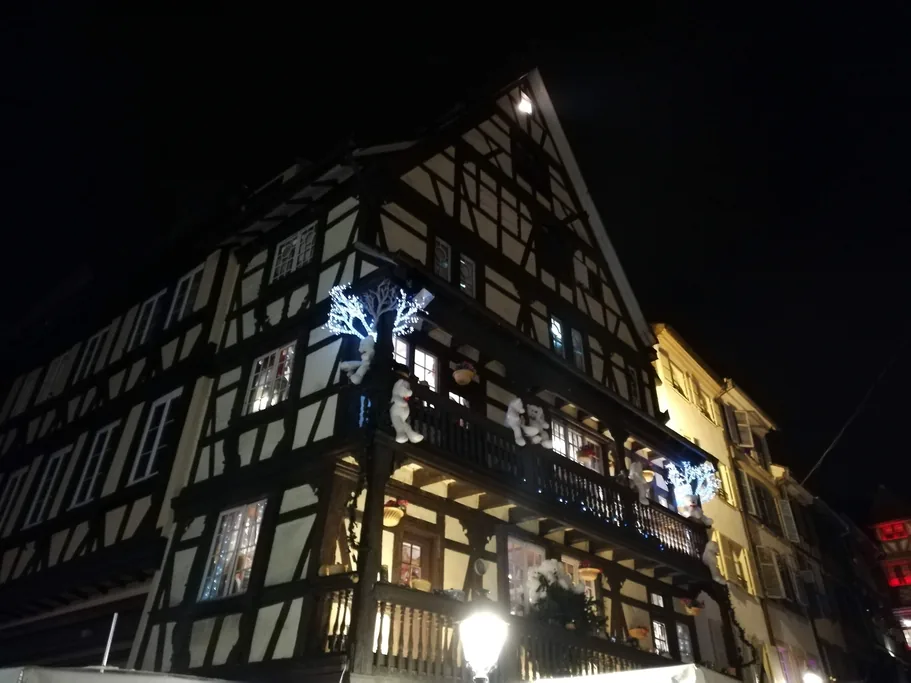
Strasbourg doesn't hold the record for stall count: it has about 300 chalets spread over a dozen squares. Most of them are on the Grande Île, a historic island about a kilometer wide and a UNESCO World Heritage site. The markets are so close together that you can walk to several squares in one evening without taking the tram. That same density is why it gets crowded: according to the city, the 2025 Christmas season drew about 3.05 million visitors. The crowds are thickest around the big tree on Place Kléber and in the streets around the cathedral, so it pays to plan which squares to visit and in what order.
Before the lights come on over the squares, Strasbourg is worth exploring on your own: the cathedral, which was the tallest building in the world for more than two centuries, the old tanners' and millers' quarters of Petite France, and the Covered Bridges over the Ill. The TouringBee audio tour leads you past all of them and points out what to look for at every stop.
Strasbourg Self-Guided Audio Tour Instant access
Three big markets: Cologne, Vienna and Nuremberg
All three cities are bigger than Strasbourg, and their markets couldn't be more different: Cologne wins on numbers, Vienna on grandeur and Nuremberg on tradition.
Cologne
Cologne's official listing for 2026 includes thirteen markets. Most are inside the old ring road, and some are no more than a ten-minute walk apart. That means you can visit several very different markets in a single evening. The best-known market sits at the foot of the cathedral on Roncalliplatz, with more than 120 stalls. It will be closed on November 22 for Totensonntag, the German Sunday of remembrance for the dead. Walking between markets naturally turns into a stroll through the Old Town, from the cathedral past the Town Hall tower to the Rhine, and the TouringBee audio tour follows much the same route.
The market that runs longest after Christmas is Heinzels Wintermärchen in the Old Town. Its Heumarkt section, with a skating rink in the middle, stays open until January 10, 2027, but closes on December 24 and 25. The neighboring Alter Markt section ends on December 23. So in Cologne, the Christmas season stretches into the first week of January.
Vienna
Vienna offers one of the grandest settings. The Christkindlmarkt fills Rathausplatz in front of the neo-Gothic city hall. It is open daily from 10:00 to 22:00 and closes at 18:30 on December 24. The main market ends on December 26, but the city doesn't empty out after that: the markets at Schönbrunn Palace and on Riesenradplatz in the Prater run until January 6, as does the ice rink outside City Hall. Vienna's smaller markets, at Freyung and in the Spittelberg neighborhood, are quieter than the main one and more pleasant for shopping.
The market is easy to fit around the rest of a Vienna trip. Spend the day on museums and the historic center, perhaps with the TouringBee audio tour, and the market will still be open when you're done: it runs until 22:00.
Nuremberg
If you're looking for the model of a traditional German Christmas market, Nuremberg is the place. In 2025, the market on the Hauptmarkt had 168 wooden stalls with red-and-white fabric roofs, all built to the same pattern. The market describes itself as Städtlein aus Holz und Tuch — "a little town of wood and cloth." That uniform look is a big part of its appeal: the stalls feel like one cohesive market rather than a hundred competing signs. The market opens on November 27, when the Christkind traditionally reads the prologue from the balcony of the Frauenkirche at 17:30. On December 24, it closes at 14:00. Expect gingerbread and gold-foil angels, not rides.
Step away from the Hauptmarkt, and the Old Town tells a far longer story than the market's. The walk up to the Imperial Castle, which the TouringBee audio tour follows, leads through a different Nuremberg: the city of emperors, craftsmen and Albrecht Dürer.
Close to Strasbourg: Colmar and the Alsatian villages
Of all the cities in this comparison, only Colmar is half an hour from Strasbourg by train, and it's the only one you can easily add to a trip without changing hotels. It's the same Alsace, just smaller and quieter, with an Old Town made up almost entirely of colorful half-timbered houses and canals.
Colmar has six markets in different parts of its Old Town, from the Dominican church to the canals of Little Venice. They open on November 23, four days before Strasbourg, and run until December 29, while a separate gourmet market on Rue de la Montagne Verte stays open until January 3, 2027. Between markets, it's easy to cover the whole Old Town, for example with the TouringBee audio tour of Colmar.
The wine villages around Colmar have Christmas markets of their own, each on its own calendar. Riquewihr lies within its medieval walls, and its market closes as early as December 20. Eguisheim is built in rings around its castle, and the market follows those circular lanes. In Kaysersberg, the stalls are up only from Friday to Sunday: on a Tuesday, you'll find a beautiful village and not a single stall. And Ribeauvillé's medieval market, with costumes and fire, lasts just two weekends. Until December 20, Christmas shuttles run from Colmar station to the villages, and on Advent weekends Kaysersberg and Ribeauvillé get busy.
Prague and Budapest
Both cities are outside the eurozone, and a trip there can be relatively inexpensive. That said, hotel and food prices near the main markets rise noticeably during the holiday season.
Prague's Christmas markets run into January. Those on Old Town Square and Wenceslas Square open on November 28 and run until January 6, 2027, so you can come between the holidays too. Old Town Square, with the twin towers of the Týn Church behind the tree, is one of the most photographed market scenes in Europe. The first twenty minutes there are genuinely impressive. But turn off the square into the lanes of the Old Town, which you can explore by day with the TouringBee audio tour, and the crowds thin out fast.
Budapest's two main markets are ten minutes apart. Advent Bazilika in front of St. Stephen's Basilica opens on November 13 and runs until January 1, 2027, with a light show on the basilica's facade after dark. The older market on Vörösmarty Square focuses on Hungarian crafts rather than imported ornaments. The basilica, Váci Street and the Danube embankment are all stops on the TouringBee audio tour, and after a few cold hours on foot, the city's thermal baths are the best place to warm up.
Zurich: a market under one roof
Zurich's main market is indoors, in the great hall of the central train station. Now known as Polarzauber, the market features more than 100 stalls with polar-themed decorations and runs from November 19 through December 24. An indoor Christmas market is rare, and in a damp December that's worth a lot. Zurich is expensive, so it's hardly worth the trip for the market alone, but if Switzerland is already on your itinerary, the station market is a welcome bonus.
Two markets, one trip
Strasbourg and Colmar: one day, no car. The train takes about 30 minutes (check times and fares). Spend a few hours in Colmar's Old Town and its markets, then be back in Strasbourg for the evening lights. Colmar's markets stay open until December 29, later than Strasbourg's has in recent years.
Cologne and Aachen: a half-day or day trip from Cologne. The fastest trains take about half an hour. Aachen's market runs from November 20 to December 23 around the town hall and Charlemagne's cathedral, and the cathedral alone makes the trip worthwhile.
Prague and Vienna: two capitals in one week. The direct train takes about four hours. Vienna's markets open on November 13 and Prague's on November 28, so in early December both are in full swing.
Which Christmas market should you visit first?
Weather and daylight matter as much as the market itself. Of the main markets in these cities, only Zurich's Polarzauber is indoors. The rest are outside. Prague, Vienna and Budapest make it easiest to wait out the rain in a museum, café or thermal bath. In December, it gets dark early in all these cities, often by 4 or 4:30 in the afternoon, so the evening belongs to the market and the rest of the day to the city.
- The classic, all on foot — Strasbourg, with Colmar half an hour away. The trade-off is the crowds.
- Lots of markets close together — Cologne.
- The most picturesque settings — Colmar and the Alsatian villages.
- A traditional German market — Nuremberg.
- A grand city and an equally grand Christmas market — Vienna.
Vienna's main market is still open on December 26. After that, the choice narrows to Prague, Budapest (until January 1), Colmar, Cologne's Heumarkt and Vienna's smaller markets.
Before booking
- Entry to all the main markets listed here is free. Guided tours, skating, rides and special events may cost extra.
- Trains from Paris. Direct high-speed trains from Paris Gare de l'Est to Strasbourg take as little as 1 hour 45 minutes (check times and fares).
- Hotels in Strasbourg cost much more than usual in December, and rooms sell out months ahead (check availability).
Planning your Christmas trip?
If we had to pick one route, we'd recommend Strasbourg in the first week of December plus a separate day in Colmar. The two cities are just half an hour apart by train. By day, you can wander the historic quarters, and after dark, head to the markets. If you're traveling after Christmas, Prague is a particularly good option, while Budapest's main market stays open through January 1.
Frequently asked questions
Which is better, Strasbourg or Cologne?
Strasbourg is better for a compact, historic setting, with its cathedral and Christmas markets clustered on the Grande Île. Cologne offers more markets to choose from and a longer season, which makes it the better choice if you want to explore several different markets. Cologne has thirteen markets listed for 2026. The first opens on November 16, and the Heumarkt market continues until January 10, 2027. Strasbourg's market, for its part, dates back to 1570.
Which is the oldest Christmas market in Europe?
Strasbourg's market is the oldest in France, but not in Europe. It dates to 1570. In Germany, Bautzen traces its market to 1384 and Dresden's Striezelmarkt to a charter of 1434. The earliest reliable evidence of Nuremberg's market dates only to 1678, and Vienna's city historians reject the medieval legend about theirs.
When is the Nuremberg Christmas market in 2026?
From November 27 to December 24, 2026, on the Hauptmarkt. It is usually open daily from 10:00 to 21:00, until 22:00 on opening day and until 14:00 on December 24. The traditional Christkind's prologue is on November 27 at 17:30.
Which Christmas markets stay open after Christmas?
Prague's two main markets run until January 6, 2027, Budapest's Advent Bazilika until January 1, Colmar's six markets until December 29 and its gourmet market until January 3. In Cologne, the Heumarkt market reopens after Christmas and runs until January 10. In Vienna, the Rathausplatz market closes on December 26, but the markets at Schönbrunn and on Riesenradplatz stay open until January 6.
Continue exploring
- The Strasbourg Christmas market guide — square by square, what to eat and how to handle the crowds
- Colmar vs Strasbourg at Christmas — which city to choose for a short trip
- Christmas markets near Colmar — the Alsatian villages, shuttles and trains
- Strasbourg in winter — the quieter weeks before and after the market

Eugene has lived in France for 16 years and worked as a tour guide before founding the travel-content network paris10.travel. He wrote the TouringBee audio tour of Strasbourg.
Every price and opening time on this page is checked against the official source for the current year. Where a fact is not yet published, we say so instead of guessing.
TouringBee audio tours are our own product. Links to Booking.com and SNCF are affiliate links: if you book through them, we may earn a small commission at no extra cost to you. It never affects what we recommend.