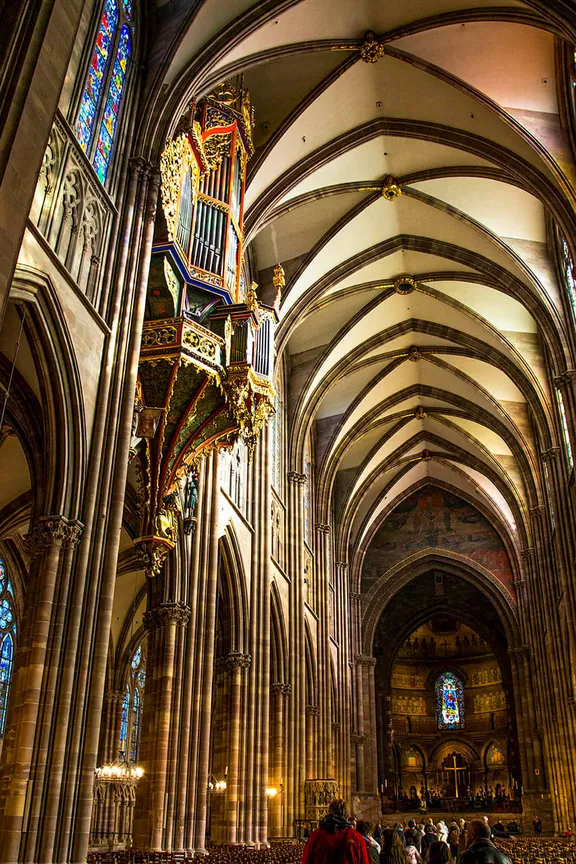
The clock stands in the south transept, and whenever the nave is open you can look at it without a ticket. Its figures move every quarter of an hour. The full show runs once a day, and to see it you need a ticket. The audience goes in through a separate entrance. A few steps away in the same transept rises the Pillar of Angels, a 13th-century sculpted column, while the rest of Strasbourg Cathedral, with its facade, stained glass and viewing platform, is best explored separately, without one eye on 12:30.
The TouringBee audio tour of Strasbourg goes inside the cathedral, and at the clock the guide explains what it shows and how the 12:30 show works. That comes in handy on a Sunday or during the Christmas market, when there is no show.
Strasbourg Self-Guided Audio Tour Instant access
At a glance
| Details | |
|---|---|
| Show | Once a day at 12:30. From 12:00 a film runs beside the clock in French, German and English |
| Entrance | From 11:30, via Place Saint-Michel, reached from Place du Château (south side of the cathedral) |
| Ticket | €4, with reduced rates for children, students and groups. Free under 6 |
| Where to buy | 10:00–11:00 at the cathedral shops, then from 11:30 at the entrance. Cards accepted. Same day only, no advance sales |
| No show | Sundays and church holidays with an 11:00 mass, and the whole time the Christmas market is on |
| Nave | Closed to other visitors from 11:15 to 12:45 |
The €4 ticket is not what you need to see the clock. It is for the 12:30 show, with the film and the procession of the apostles.
The Christmas market opens on Friday, November 27, 2026, and runs until December 24. While the market is on, the cathedral is open Monday to Saturday from 08:30 to 17:45 without a midday break, and visitors enter through the south portal on Place du Château. There is no clock show during those weeks.
Why 12:30
The time was not picked to suit tourists. The silver hands show official time, and the gold hands show Strasbourg's mean solar time. The city lies well west of the meridian that sets Central European Time, and in winter the gap between the two is about half an hour. So noon on the gold hands falls at 12:30 by our watches. The chimes and the astronomical dials follow the gold hands.
You have probably noticed that it gets dark early in winter and the days stretch out in summer: the sun does not keep the same schedule all year. Noon is no exception. The moment when the sun stands highest over the cathedral comes earlier in some months and later in others, sometimes by a quarter of an hour. Mean solar time smooths that out, so on it every day lasts exactly 24 hours. That makes 12:30 noon by Schwilgué's clock, not by the sun on any given day.
In summer France moves to daylight saving time, and local noon would drift to 13:30. To prevent that, the clock is adjusted for the summer, and the apostles still come out at 12:30 official time.
What happens on the clock
Four figures, the four ages of a human life, take turns passing before Death: a child at the first quarter, a youth at the half hour, a grown man at the third quarter and an old man at the top of the hour. Above them, one angel strikes each quarter while a second turns over an hourglass.
At 12:30 the figures on the upper tier start moving too. The twelve apostles pass before Christ, who blesses them. The rooster on the small tower to the left flaps its wings and crows three times, recalling Peter's three denials. Lower down, above the calendar, the chariots of the days of the week each carry their own god: Apollo on Sundays, Diana, goddess of the Moon, on Mondays, then Mars, Mercury, Jupiter, Venus and Saturn. Say the French weekdays out loud, lundi, mardi, mercredi, jeudi, vendredi, and you can hear the same names.
The figures are small, and the niches they move in sit high up. It is a short mechanical show, not a light-and-sound spectacle. Anyone expecting a performance on the scale of the cathedral may come away disappointed. The clock rewards people who know what it is calculating.
What the mechanism calculates
Beneath the figures runs a perpetual calendar. A large ring shows the fixed-date feasts and saints' days. The mechanism handles leap years by itself. On the night of January 1, a separate unit on the left, the comput ecclésiastique, works out the date of Easter for the coming year, and with it all the movable feasts. Scholars and churchmen argued for centuries over how to calculate Easter, and here gears do it once a year.
The center of the lower section shows the positions of the sun and moon, and the mechanism reproduces solar and lunar eclipses. On the planetary dial, the planets out to Saturn circle the sun. The celestial sphere shows the sky as seen from Strasbourg, and one of its wheels takes 25,806 years to complete a turn. That is how the mechanism models precession, the slow wobble of the Earth's axis, which takes about 25,800 years.
Three generations of clocks
The clock you see is the cathedral's third.
The first clock, 1354. The Clock of the Three Kings stood against the opposite wall of the transept. It stopped in the early 16th century, but its rooster survived. Made of painted wood and wrought iron, the bird was already flapping its wings and crowing in the 14th century. It is now considered the oldest surviving automaton in the West, and it stands in the Museum of Decorative Arts in the Palais Rohan, across the square from the cathedral.
The second clock, 1547–1570s. Work on it soon came to a halt, and it was finished only some twenty-five years later, on the spot where the current clock stands. It brought together the mathematician Conrad Dasypodius, the clockmakers Isaac and Josias Habrecht and the painter Tobias Stimmer, who decorated the case. That clock made the city famous, and in 1788 its iron wheels finally wore out and it stood still for half a century.
The third clock, 1838–1842. This is the one in front of you. Its mechanism was built by Jean-Baptiste Schwilgué, a self-taught Alsatian engineer who had wanted to repair the clock since boyhood. He was not allowed to build a new case: the city authorities insisted on keeping the Renaissance one. So a 16th-century cabinet now holds a 19th-century mechanism.
The legend of the blinded clockmaker
One of the city's stories about the clock goes like this: the authorities supposedly had its maker blinded so he could never build another one for a rival city. Prague tells almost exactly the same legend about its astronomical clock.
The records do not support it. Isaac Habrecht lived for nearly half a century after the Strasbourg clock and kept working. The British Museum holds a large carillon clock he made in Strasbourg in 1589, and its dials and figures copy the cathedral's in miniature. If anything, the legend shows how highly the city valued its clock.
How to get into the show
- Buy your ticket on the day. From 10:00 to 11:00 tickets are sold at the cathedral shops, and from 11:30 at the show entrance. The cathedral does not sell them in advance, online or anywhere else.
- Find the separate entrance. It is not the main door on the cathedral square: walk around the right-hand side of the cathedral to Place du Château, and from there through to Place Saint-Michel.
- Arrive by 11:30. The figures are set high and many details are small, so it pays to get a place close to the clock. From 12:00 a film about the astronomical clock plays on a screen nearby, so by 12:30 you will know what to watch for.
- Be wary of skip-the-line offers. If someone online offers you priority entry to the clock, it is most likely a guided tour. Walks like that are among the Strasbourg Cathedral tours on GetYourGuide, but they usually don't include a ticket for the show.
- Keep exploring afterward. From 12:45 the nave usually reopens to everyone, and unless a service is on, you can stay and see the rest of the cathedral.
The city around the cathedral
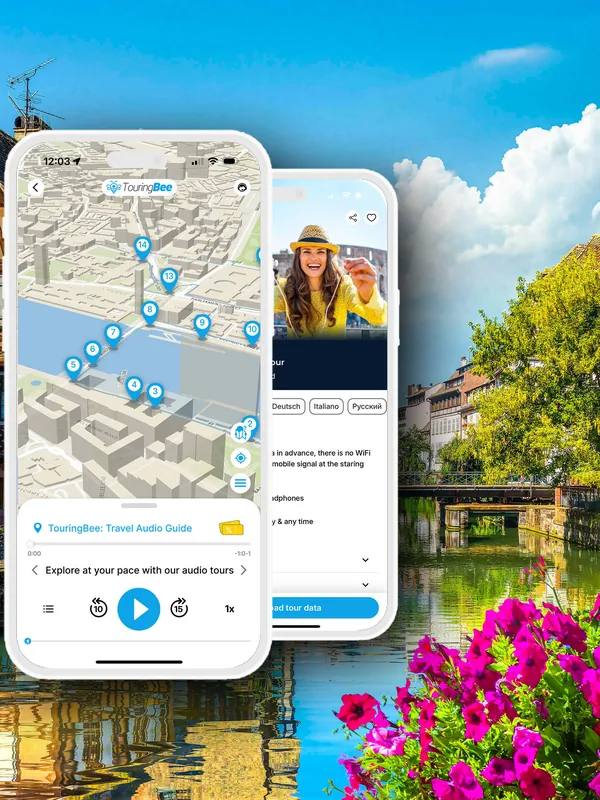
The TouringBee audio tour starts near the train station and runs through Petite France, the Ponts Couverts and Cathedral Square, with stops outside the cathedral and inside it. You can start the walk whenever you like and reach the clock before the show, after it or on another day. If you want to catch the show on the day of your walk, keep in mind that the audience entrance opens at 11:30 and tickets are sold on site.
- 33 stops, about 2.5 hours at your own pace, recordings of 1–3 minutes.
- From €9.99, one-time payment, one year of access, 8 languages.
- Download the tour before you set out, and the map and audio work offline.
- The map shows where you are, and you start each recording yourself when you reach the spot. Inside the cathedral, headphones work best, and the audio won't start on its own at the wrong moment.
Visiting the cathedral?
The figures on the clock are small, and the procession is brief. They become far more interesting once you know what lies behind them: a clock that keeps Strasbourg's own time, works out Easter by itself and shows the sky over the city. And the mechanical rooster above them carries on a tradition that began with the first clock in the 14th century.
Frequently asked questions
What time is the Strasbourg astronomical clock show?
Once a day at 12:30, with a film from 12:00 before it. There is no show on Sundays, on church holidays with an 11:00 mass or during the Christmas market.
How much is a ticket?
€4, with reduced rates for children, students and groups. Free under 6.
Can I buy tickets in advance?
No. The cathedral sells tickets only on the day: 10:00–11:00 at the cathedral shops and from 11:30 at the entrance.
Why is the show at 12:30 and not at noon?
The clock runs on Strasbourg's mean solar time, which in winter is about half an hour behind official time. Noon on its gold hands falls at 12:30. In summer the clock is adjusted so the show stays at 12:30.
Can I see the clock for free?
Yes, whenever the nave is open. The figures of the four ages move every quarter hour. You only need a ticket for the 12:30 show.
Who built the astronomical clock?
The current mechanism was built by Jean-Baptiste Schwilgué between 1838 and 1842. It sits in the Renaissance case of the second clock, made in the 1570s by Conrad Dasypodius, the Habrecht brothers and Tobias Stimmer.
Continue exploring
- Strasbourg Cathedral — the facade, the stained glass and the 330 steps to the platform
- One day in Strasbourg — a timed route with the morning built around 12:30
- Strasbourg walking tour — a free loop through the center that ends at the cathedral
- Strasbourg Christmas market — how the cathedral's schedule changes in December

Eugene has lived in France for 16 years and worked as a tour guide before founding the travel-content network paris10.travel. He wrote the TouringBee audio tour of Strasbourg.
Every price and opening time on this page is checked against the official source for the current year. Where a fact is not yet published, we say so instead of guessing.
TouringBee audio tours are our own product. Links to GetYourGuide are affiliate links: if you book through them, we may earn a small commission at no extra cost to you. It never affects what we recommend.