Still planning the whole trip? Start with our complete guide to Strasbourg, then come back here for the walk.
So here is a free loop that takes about ninety minutes, covers the four things people regret missing, and ends where you will want to have dinner. Screenshot it and walk it — every street, bridge and terrace on it is public.
It is not our audio tour, and we will not pretend otherwise. The TouringBee self-guided audio tour of Strasbourg is a different animal: it runs about two and a half hours, starts over at the station, and works through the city in an order built for a narrator rather than for a map. This page is the short version you can walk with your phone in your pocket and nothing in your ears, from €9.99 if you decide you want the long one.
Go late in the day. The cathedral closes 11:15–12:45, the clock performs at 12:30, and the low sun turns the sandstone properly pink after four. Staying on the Grande Île means the loop starts at your door.
At a glance
- The loop — about 3 km, roughly 90 minutes at a pace that lets you look at things
- Start and finish — Place de la Cathédrale. It is a loop; you come back to it
- Cost — €0. Every street, square, bridge and terrace on it is free
- Best time — start around 16:00, earlier in winter
- Cathedral nave — free. Mon–Sat 08:30–11:15 and 12:45–17:45, Sun 14:00–17:15
- Surface — cobbles nearly throughout. Not a day for new shoes
- If you want the long version — 33 stops, about 2.5 hours, 8 languages, from €9.99
Three ways to walk Strasbourg, compared honestly
Strasbourg Boat Cruise on the Ill Timed entry
Search "strasbourg walking tour" and you are choosing between three things that do not really compete on the same axis.
A guided group tour gives you a human who can answer a question. It also runs to a fixed clock — out at 10:00, back at 12:00 — so if the group dawdles in Petite France you get four minutes at the covered bridges.
A free walking tour costs nothing to join and the guides are often very good. They also work for tips: groups run large, you will be at the back straining to hear, and the envelope at the end costs roughly what a cheap paid tour would have.
A self-guided audio tour has nobody to ask. That is the trade-off, and it is a real one. In exchange you start when you want, break for lunch, and replay the bit you were not listening to.
| Self-guided audio | Guided group tour | Free walking tour | |
|---|---|---|---|
| Price | From €9.99 once, a year of access, any number of walks | Per person, per departure | Free to join, tip expected |
| Pace | Yours — stop, eat, split it over two days | Fixed start and finish | Fixed, usually brisk |
| Group size | You and whoever you brought | Typically 10–25 | Often 25+ |
| Languages | 8 — EN, FR, DE, ES, IT, PT, PL, RU | Whatever the guide speaks that day | Usually English or French |
| Bad weather | Postpone, lose nothing | You paid for that slot | Awkward |
Want a human? Tours and cruises in Strasbourg are easy to book. Want the city on your own clock? Keep reading.
The free ninety-minute loop
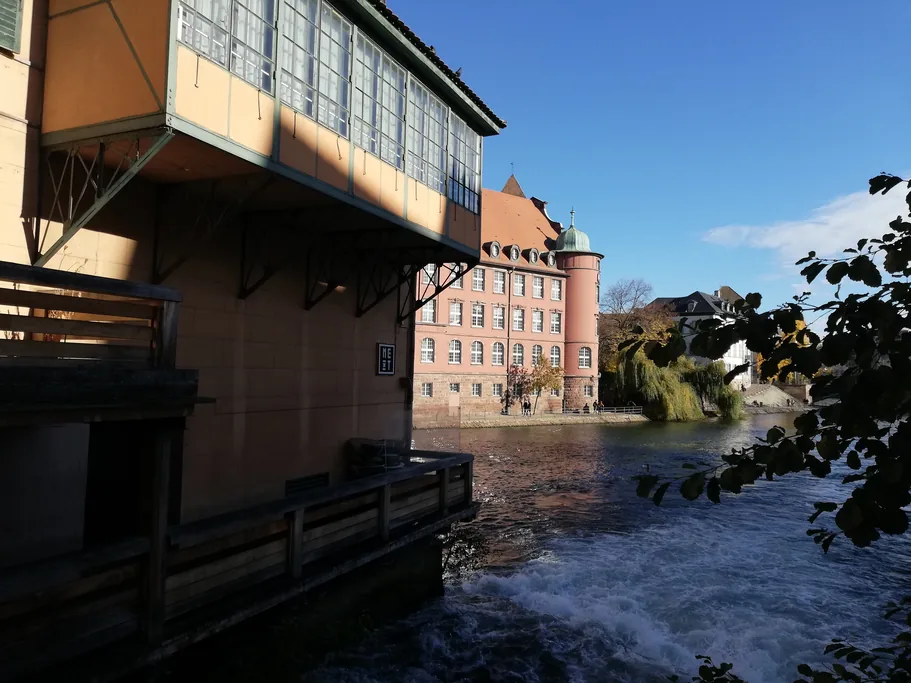
Walk it in this order. It is built backwards from the light: you leave the cathedral square while it is still busy, spend the golden hour on the water, and come back when the facade has gone pink and the crowds have gone to dinner.
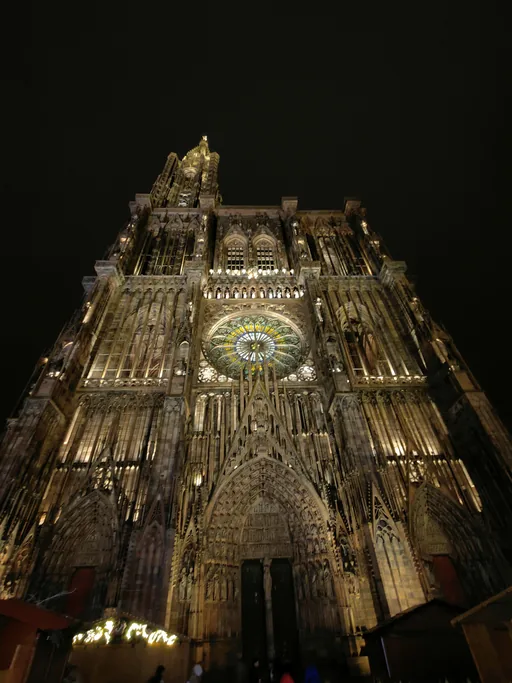
1. Place de la Cathédrale — ten minutes, then leave. Stand well back, near the corner of Rue Mercière, or you cannot see the top. 142 metres; nothing built by humans stood taller from 1647 to 1874. The south tower was never finished — the money ran out — and that lopsided silhouette is how you recognise Strasbourg in any photograph. The nave is free; the platform is 330 steps and €10, the clock €3 at 12:30, both sold on site only. Go inside now if you are going at all, then walk away from the square. You will be back.
2. Rue Mercière and Place Gutenberg — ten minutes. Rue Mercière is the postcard shot, and it works best from the far end looking back, not halfway along. It opens onto Place Gutenberg, the old Green Market, which is where the public toilets are and where the square stops being about the cathedral.
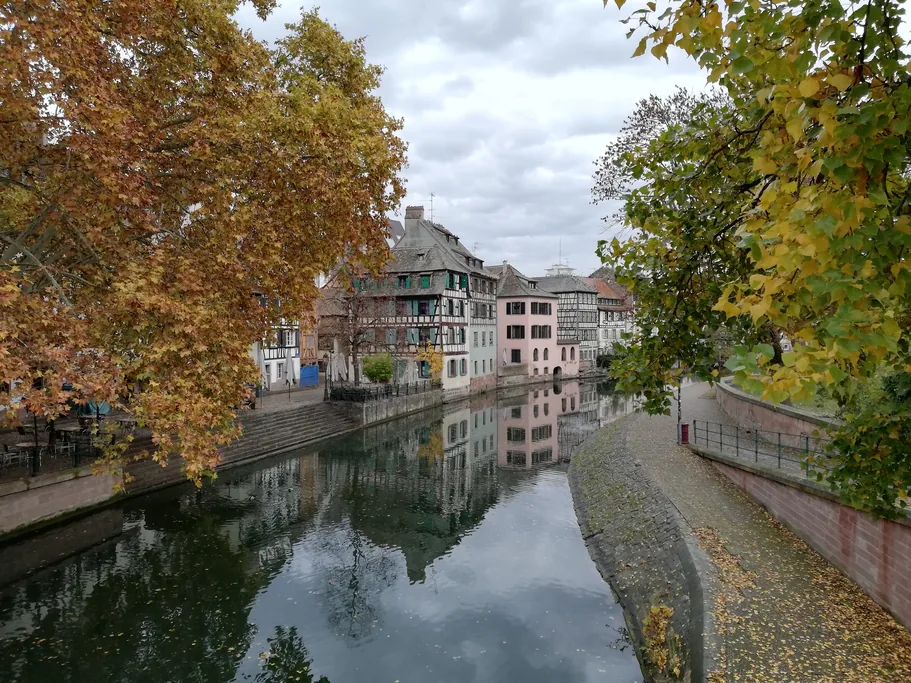
3. Down to the water at Pont du Corbeau — fifteen minutes. Cross to the south bank and turn west along the quai. This is the stretch most visitors skip, and it is the one where you stop walking through a monument and start walking through a city: barges, the backs of houses, the 1588 slaughterhouse that is now the Musée Historique, and the Palais Rohan behind it. Museums are €7.50 each or €16 for a day pass; the Musée Alsacien is closed for renovation until 1 June 2028.
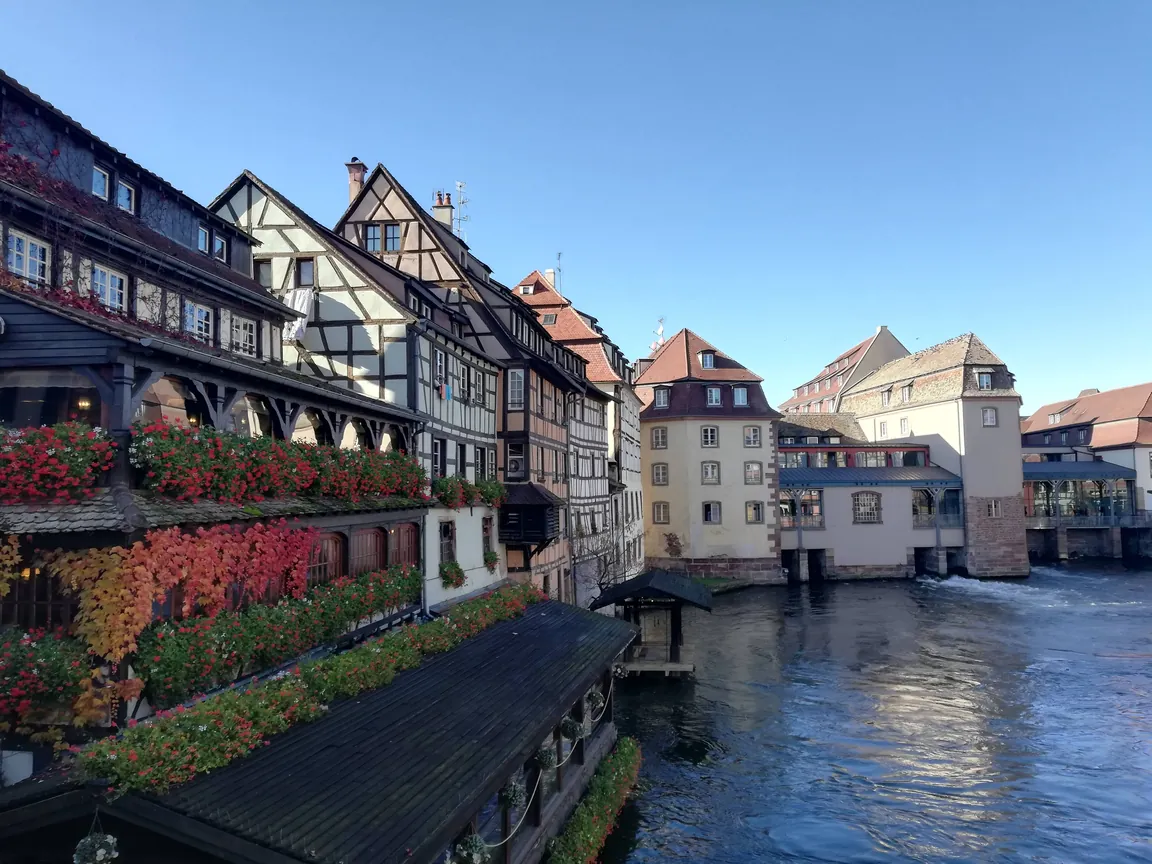
4. Petite France — twenty-five minutes, more if you sit down. Cross back at the footbridge and follow the water into the tanners' quarter. Look up at the roofs: those rows of small windows are not decoration, and once you spot the pattern you will find it on four more houses. If the Pont du Faisan starts turning, stop and watch — it swings sideways to let boats through and takes about three minutes. Between 11:00 and 17:00 this is the busiest 200 metres in the city; by six it empties out.
5. Ponts Couverts and the Barrage Vauban terrace — fifteen minutes. Do not skip this. Four square towers stand in the water; the dam beyond them was finished in 1688 as a piece of military engineering, not decoration. Climb to the roof terrace. It is free, it has a lift as well as stairs, and it is the best view in Strasbourg that costs nothing: covered bridges in front, cathedral spire behind, the whole island between them. The only better view costs €10 and 330 steps.
6. Back east along Rue des Moulins — fifteen minutes, or two hours if you eat. Nearly every building on it is a restaurant. Order baeckeoffe — three meats layered with potato and onion, sealed under a strip of dough and slow-baked — about €18–22 in a winstub here. Kitchens mostly run 12:00–14:00 and 19:00–21:30, so arrive at seven or expect to wait. Then walk back up to the cathedral square and look at the facade again. It is a different building in this light, and the square is finally quiet.
That is the loop. What it deliberately leaves out is most of the city's story — who lived in those houses, what the towers were for, why the quarter got its name and why the square is always windy. None of that is on a plaque. It is the reason the long version exists.
Strasbourg Self-Guided Audio Tour Instant access
What the walk actually costs
Nothing, unless you go inside something:
- The loop itself — €0, including the Vauban roof terrace and the cathedral nave
- Astronomical clock — €3 adult, €2 reduced, same-day tickets only
- Tower platform — €10 adult, €6 reduced, on-site sale only, 330 steps
- Municipal museums — €7.50 each, or €16 for a day pass
- Dinner on Rue des Moulins — €18–22 for a main, less at lunchtime
- The audio version — from €9.99 once, a year of access
When to walk it
Time of day. Start around 16:00 from March to October, around 14:00 in winter. You get the water in good light and the cathedral square twice: once busy, once empty.
Morning instead? Then reverse it — Petite France before 09:30 is almost yours alone, and the light falls on the timber rather than behind it.
Season. Spring and early autumn are the easy answer. In December the loop runs straight through the Christmas market: the Christkindelsmärik has run since 1570 and takes over most of these squares from the last week of November to 24 December. See our Christmas market guide.
Rain. The loop has exactly two roofs: the Vauban gallery and the cathedral nave. Reorder around them and a wet day still works.
The audio guide
This page gives you a short loop. The TouringBee self-guided audio tour of Strasbourg gives you the long one — a different route, a different order, and a voice explaining what you are looking at while you stand in front of it.
- 33 stops across about 2.5 hours, recordings of 1–3 minutes each
- From €9.99, one payment, one year of access, no subscription
- 8 languages — English, French, German, Spanish, Italian, Portuguese, Polish, Russian
- Fully offline once downloaded — no roaming, no Wi-Fi hunting
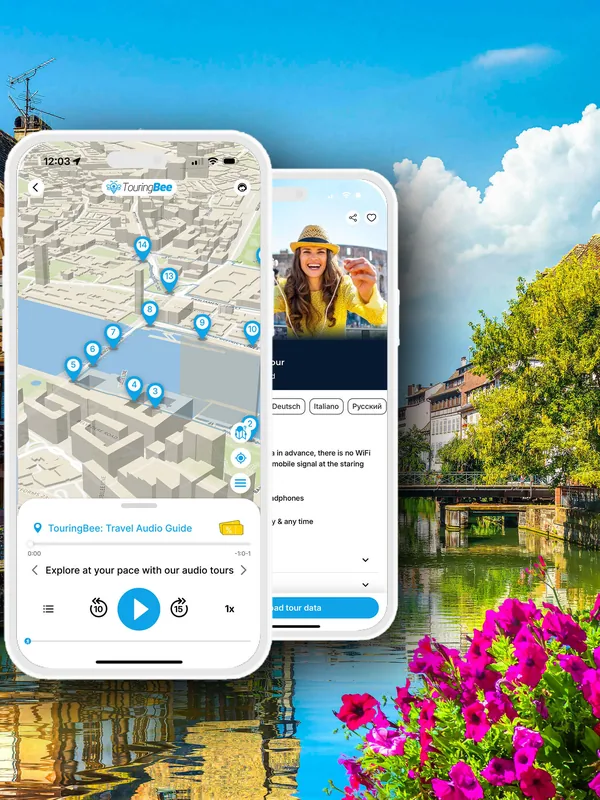
- How the map works: the app shows an offline GPS map with your position, so you always know where you are and what is next. It does not auto-play. You press play yourself when you arrive.
- Rated 4.7 in the App Store and on Google Play; 4,664 travellers have listened to a TouringBee tour
"I'm a 64 year old female solo traveler. I walked around the city of Strasbourg whole day with this guide, taking a break at my hotel room as needed. It's flexible yet comprehensive. The length of recording at each of the 33 landmarks was just right (2–3 minutes)."
— Reiko_T, GetYourGuide, September 2025
Get the Strasbourg audio tour — from €9.99
Ready to walk it?
Start at the cathedral around 16:00 and the loop brings you back in better light.
Frequently asked questions
How long does a walking tour of Strasbourg take?
The free loop on this page takes about 90 minutes at a normal pace, roughly 3 km. A full self-guided tour of the Old Town runs about 2.5 hours. Add an hour for the cathedral interior, or a whole day with museums and a long lunch.
Can I walk Strasbourg for free?
Completely. Every street, square, bridge and viewpoint on this loop is free, including the roof terrace of the Barrage Vauban and the cathedral nave. Only the extras cost money: the tower platform (€10), the astronomical clock (€3) and the municipal museums (€7.50 each).
What is the best starting point?
Place de la Cathédrale, because everyone can find it and because the loop is built to bring you back to it in better light. If you are starting from the station instead, walk east for five minutes to the water and pick the loop up at Petite France.
Is Strasbourg walkable?
Yes, unusually so. The historic centre sits on one island and is almost entirely pedestrianised, so you will not need a tram or a taxi anywhere on this route. Watch for bicycles rather than cars — Strasbourg has over 560 km of bike lanes and locals ride fast.
Do I need to book a guided tour?
No. Nothing on this loop needs a guide to enter. Book one if you specifically want a person to ask questions of; otherwise a self-guided audio tour covers far more ground with no fixed departure time.
Is the audio guide GPS-triggered?
No, and we would rather say so plainly. The app shows an offline map with your position, so you always know where you are and what is next — but you start each recording yourself when you reach the stop. Nothing plays automatically.
Can I do this walk in winter?
Yes, and in December it runs straight through the Christmas market. Start earlier — around 14:00 — because the light goes by half past four.
Continue exploring
- Complete guide to Strasbourg — when to come, where to stay, what it all costs
- One day in Strasbourg — the full day, with lunch, a boat and a plan for the evening
- Petite France — the quarter in detail, and how to photograph it without the crowds
- Strasbourg Cathedral — hours, the climb, the clock, and what to find inside
- The Old Town and the Grande Île — why the whole island is the UNESCO site

Eugene has lived in France for 16 years and worked as a tour guide before founding the travel-content network paris10.travel. He wrote the TouringBee audio tour of Strasbourg.
Every price and opening time on this page is checked against the official source for the current year. Where a fact is not yet published, we say so instead of guessing.
Some links on this page are affiliate links (GetYourGuide, Booking.com, SNCF). If you book through them we may earn a small commission at no extra cost to you. It never affects what we recommend.