The island is small: about a kilometer long, fifteen minutes on foot from end to end, and not a single hill. Its history, though, is long and tangled. Look closely at the houses and you start to notice how French and German pasts are woven together in Strasbourg. The facades don't explain much on their own, and the plaques usually give little more than a couple of dates. That's where the TouringBee audio tour of Strasbourg comes in: 33 stops, about two and a half hours at your own pace.
Strasbourg Self-Guided Audio Tour Instant access
At a glance
| What to know | |
|---|---|
| Size | About 1 km (0.6 mi) long, roughly 15 minutes on foot, no hills |
| UNESCO | Grande Île listed since 1988, together with the Neustadt since 2017 |
| Landmark | The cathedral spire, 142 m (466 ft), visible from many streets |
| From the station | About 10 minutes on foot to the western edge of the island |
| Free | All streets, squares, bridges and riverside walks |
Why the Grande Île is a real island
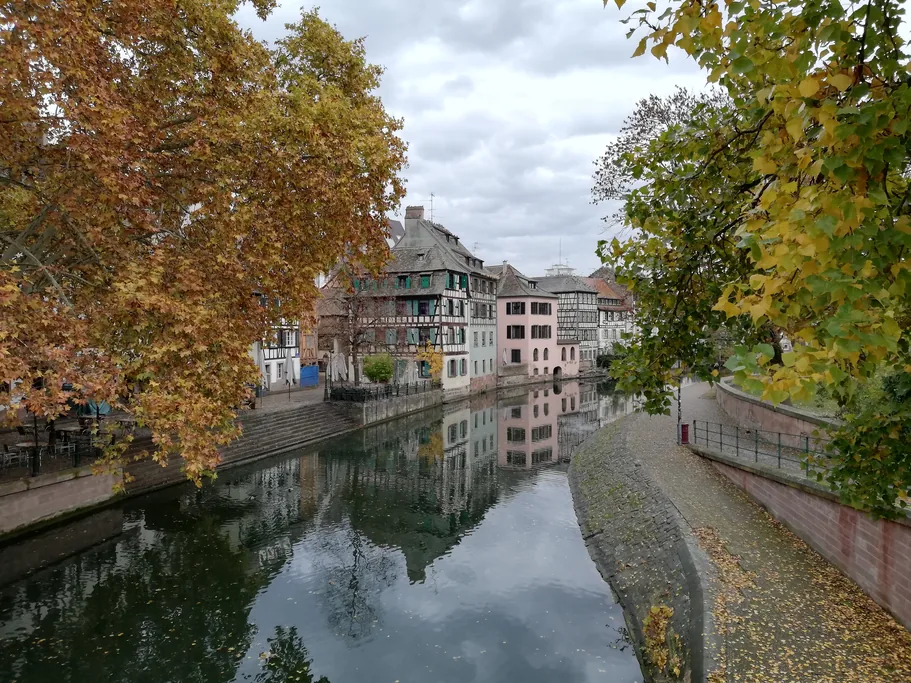
There really is water on every side. One arm of the Ill curves around the south of the town, while the other, the Faux-Rempart canal, runs along the north side, where a moat once was. At its narrowest, the island is only a few hundred meters wide.
For defense, the location was hard to beat, and the Romans saw that early on: they built a fortified camp here called Argentoratum. Over time, medieval Strasbourg grew up on the same spot, and the river remained part of the city's defenses for a long while. In the Middle Ages, Strasbourg became a Free Imperial City. In 1681 it came under the rule of the French king, in 1871 it became part of the German Empire, and in 1918 it returned to France. Through all of it, the island stayed an island.
In 1988, UNESCO added the entire historic center to the World Heritage List as a single site rather than as a set of individual buildings. In 2017, the protected area was extended across the river to the Neustadt, the German district built after 1871.
What the sandstone and half-timbering tell you
In old Strasbourg, stone buildings and timber-framed houses stand side by side, and that's one of the real pleasures of walking the island.
Strasbourg Cathedral doesn't always look pink. On an overcast day its stone looks almost gray, and in sunshine it takes on a warm, rosy tone. The reason is the sandstone from the Vosges mountains, which gets its color from iron compounds. The same stone went into many of the city's grander buildings, not only the cathedral.
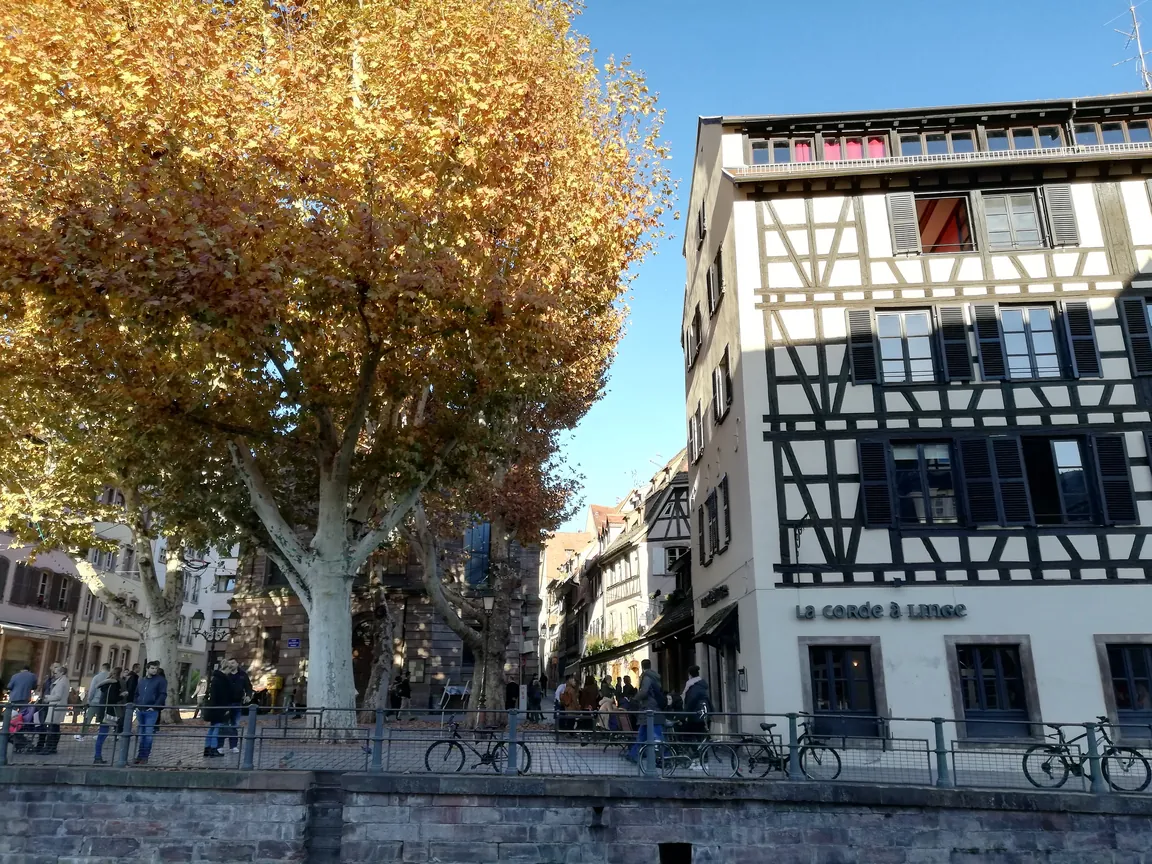
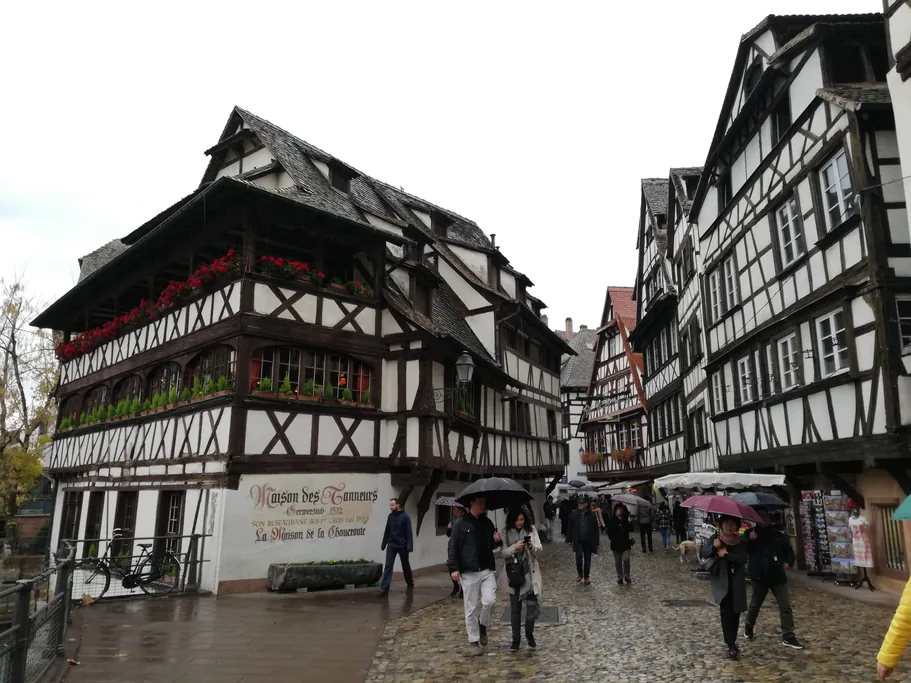
You might assume a timber-framed house belonged to a poor family. Not in Strasbourg: half-timbering turns up in modest homes and wealthy merchants' mansions alike. Take the Kammerzell House next to the cathedral, rebuilt by a prosperous merchant in the late 16th century. The construction is clever: the frame carries the load, diagonal braces keep it from twisting, and the gaps were most often filled with clay mixed with straw. Some timber-framed facades were plastered over at some point. Later, once half-timbering came to be valued as part of the city's character, the beams on those houses were uncovered again.
Look up when you stand next to a timber-framed house. The upper floors jut out beyond the ones below, sometimes even over the street. The usual explanation is taxes: supposedly they were based on a house's footprint at ground level, so it paid to build outward higher up. Historians disagree on how true that is. What is certain is that overhanging floors added living space without enlarging the plot at ground level.
Hear the stories behind the facades
33 stops from the train station through Petite France to the cathedral, at your own pace and offline.
Finding your way around the island
The cathedral spire is visible from many streets. There's only one, since the second tower was never built, so there's nothing to confuse it with. Spot the spire and you know where the center is.
Your second landmark is the water. If you get lost in the side streets, look for the river or the canal: from most of the old town, it isn't far. In many places, riverside walks run along the water, and they make it easy to get back to a bridge you recognize.
Large parts of the center are car-free. Bikes, though, are everywhere: Strasbourg is one of the most bike-friendly cities in France. Cyclists ride fast and quietly, so it pays to look both ways at intersections.
From the train station, it's about a ten-minute walk to the western edge of the island. Train times from Paris, Frankfurt and Basel are easy to check on SNCF Connect. If you'd like to stay close to the old town, compare places to stay in Strasbourg on Booking.com.
What's where on the island
The cathedral and Place Gutenberg
In the eastern part of the island, among narrow medieval streets, rises the cathedral. One of the best views of it is from Rue Mercière, which leads straight to the west facade, with the spire towering over the rooftops around it. Behind the cathedral, on quiet Place du Château, is the entrance to the astronomical clock show, and a short walk to the southwest is Place Gutenberg. A bronze statue of Gutenberg by David d'Angers has stood at its center since 1840.
St. Thomas Church
Farther south, closer to the river, stands St. Thomas Church. Its story is bound up with the Reformation, a defining chapter in Strasbourg's history. The church became Protestant in 1524, and soon even the cathedral followed. In 1681, the cathedral returned to Catholic use. St. Thomas, however, remains one of Strasbourg's main Protestant churches to this day.
Grand'Rue and Petite France
The Grand'Rue stretches west across the old town. It looks thoroughly medieval, but its history goes back much further: the street follows the line of a Roman road. Today, 16th-century half-timbered houses stand next to 18th-century stone buildings along its length. At the western tip of the island lies Petite France, the old tanners' quarter, where the Ill splits into several channels. The Ponts Couverts are right there, with the Barrage Vauban a little farther on.
Place Kléber and Place Broglie
In the center and north, the island opens out into broad squares. Place Kléber is the largest on the Grande Île, and in December it holds the city's main Christmas tree. Nearby stretches the long Place Broglie, where horses were once traded. It's tied to the story of the "Marseillaise": in 1792, Rouget de Lisle wrote what would become France's national anthem in Strasbourg at the request of Mayor Dietrich, and according to the traditional account, the song was first performed at the mayor's house on this square.
Bridges and views of the island
In the Middle Ages, the river crossings were guarded as closely as the city walls, with gates, towers and fortifications, and some of them still stand by the Ponts Couverts. The Pont du Corbeau to the east has a darker past: condemned prisoners were once executed here by being plunged into the river.
The island is easiest to take in from a distance. A Batorama boat tour shows it from the water. The main route takes a little over an hour and passes the old town, the Neustadt and the European Quarter. From the cathedral's viewing platform, 66 meters (217 ft) up, you can see the whole loop of the river. Access to the platform costs €10, and tickets are sold only on site, on the day of your visit. You'll find boat trips and walking tours of Strasbourg on GetYourGuide.
Beyond the island
Many visitors never make it to the other bank, even though the Neustadt is right there and walking it is one of the best free things to do in Strasbourg. Cross the bridge to the northeast and narrow lanes give way to broad avenues, half-timbering to heavy stone facades, and low old houses to buildings five or six stories high. The German authorities built this district after 1871. At its heart is Place de la République, with the Palais du Rhin and a war memorial of a mother cradling two sons who died fighting on opposite sides of the front.
Strasbourg with an audio guide
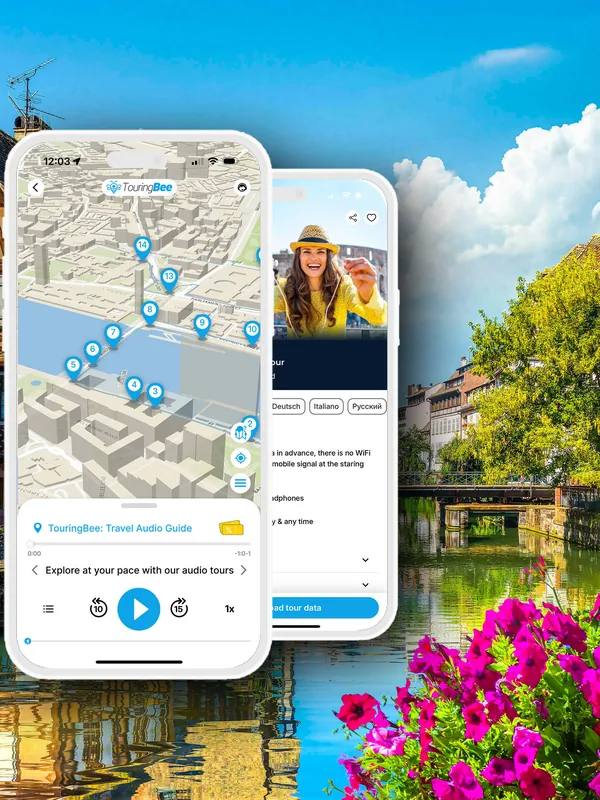
The TouringBee audio tour starts at the Pont Kuss, five minutes from the train station, and ends at St. Paul's Church. Start whenever you like and play each recording when you reach the stop. You can pause the tour and pick it up again the next day, since access lasts a full year.
- 33 stops, about 2.5 hours at your own pace, recordings of 1–3 minutes.
- From €9.99, one-time payment, one year of access, 8 languages.
- Download the tour in advance, and the map and recordings will work without an internet connection.
- The map shows where you are, making it easy to find the next stop.
Ready to explore Strasbourg?
Old Strasbourg has a rare quality: it feels remarkably whole, even though it was built and rebuilt over many centuries. Maybe it comes down to the island itself. The water draws its boundaries, the cathedral spire keeps you from losing the center, and since 1988 the whole ensemble has been protected by UNESCO. Only a ten-minute walk separates medieval lanes lined with half-timbered houses from the broad avenues of the Neustadt, and seeing them side by side makes it clear how different eras shaped Strasbourg. Before you start ticking off the sights, take your time wandering the old town. It isn't far from the cathedral to Petite France, and there's plenty to see along the way.
Frequently asked questions
What is the Grande Île?
The island that holds Strasbourg's historic center. It's surrounded on all sides by arms of the Ill River and a canal, and it's home to the cathedral, Petite France and the city's main squares.
Why is Strasbourg's old town a UNESCO site?
In 1988, the entire historic center on the island was listed as a single ensemble. In 2017, the Neustadt, the German district from the late 19th century, was added.
Why do half-timbered houses overhang the street?
It's often put down to medieval taxes on a building's footprint, but historians aren't convinced. What is certain is that overhanging floors added living space without enlarging the plot at ground level.
Can you get lost in the old town?
Not for long. The cathedral spire is visible from many streets, and from most of the center you're never far from the river or the canal, which mark the edge of the island.
How is the Grande Île different from the Neustadt?
The Grande Île is the medieval center, with narrow lanes, half-timbered houses and the cathedral. The Neustadt is the German district to the northeast, built after 1871, with broad avenues and monumental stone buildings.
Further reading
- Strasbourg travel guide — the essentials about the city
- Strasbourg Walking Tour — a free loop through the center
- Petite France — the tanners' quarter, the Ponts Couverts and a free terrace
- Strasbourg Cathedral — the facade, stained glass, the clock and 330 steps
- One Day in Strasbourg — an hour-by-hour itinerary
- Strasbourg history — why the city looks both French and German

Eugene has lived in France for 16 years and worked as a tour guide before founding the travel-content network paris10.travel. He wrote the TouringBee audio tour of Strasbourg.
Every price and opening time on this page is checked against the official source for the current year. Where a fact is not yet published, we say so instead of guessing.
TouringBee audio tours are our own product. Links to GetYourGuide, Booking.com and SNCF Connect are affiliate links. If you book through them, we may earn a small commission at no extra cost to you. These partnerships never influence our recommendations.